Explore a curated stream of blogs, articles, podcasts and insights created by treasury professionals. Our content is designed to inform, challenge, and inspire. Stay up to date, sharpen your perspective and engage with ideas that move treasury forward in a complex financial world.
This article is a contribution from our partner, Embat
As finance temas evolve from manual, file-based operations to real-time data-driven environments, one technology is quietly reshaping the backbone of financial connectivity: APIs (Application Programming Interfaces). For years, finance teams have been forced to rely on SWIFT files, SFTP servers, and nightly batch updates. Today, APIs are enabling instant access to cash positions, real-time payment execution, and seamless data flows between systems. The result? Faster decision-making, better control, and radically improved operational efficiency.
But what does it actually mean to “connect your TMS to your ERP and your banks via API”? In this article, we’ll break down the API building blocks of a modern treasury stack, explain how to integrate them, and share a real-world example of what this looks like in action.
APIs are software interfaces that allow different systems to “talk” to each other in real time. Think of them as the pipes that connect your treasury plumbing: your ERP (where transactions originate), your TMS (where liquidity and risk are managed), and your banks (where cash is held and moved). Instead of uploading files or sending emails, APIs enable direct, instant communication between these systems.
In treasury, this means:
APIs reduce manual errors, enhance visibility, and provide agility in responding to market changes — all of which are critical in today’s volatile financial environment.
To understand API integration, let’s break the treasury tech stack into three parts:
This is your accounting system — SAP, Oracle, Microsoft Dynamics, Netsuite , etc. — where invoices, payroll, and vendor payments originate.
This is the control tower for treasury. It manages cash flow forecasting, FX risk, intercompany loans, and bank account visibility.
These are your cash custodians. Banks offer APIs for balance reporting, payment execution, transaction notifications, and FX services.
APIs connect these three layers, enabling a seamless data exchange between operational finance (ERP), strategic decision-making (TMS), and execution (banks).
A typical API integration follows this flow:
Your ERP sends payment proposals, forecasted cash flows, and invoice data to your TMS via API. This helps the TMS consolidate positions and project liquidity across time horizons.
The TMS sends validated and approved payments, FX deals, or sweeping instructions to your bank via its corporate API. Banks respond instantly with confirmations, reference numbers, or error messages.
Your TMS receives real-time balance and transaction data from each bank account via API. This data can also be passed to the ERP for reconciliation and reporting purposes.
Together, this closed loop allows treasurers to manage cash, risk, and payments from a single interface — without ever exporting a file.
When integrating APIs in treasury, data protection and access control are essential. Key areas to focus on:
In short, treat APIs like opening a digital vault: only the right people and systems should ever get the key.
Implementing API integrations doesn’t have to be a chaotic and complex project. Follow these principles for a smooth rollout:
A European technology company using Embat’s TMS integrated its ERP (Netsuite) and two main banking partners via API. The project enabled the following:
The result: 90% fewer reconciliation errors, cash visibility by 9:00am every day, and real-time FX rate validation before settlement. What used to take hours and emails now happens automatically, every day.
APIs are no longer a buzzword — they are the foundation of a modern treasury infrastructure. By connecting your TMS, ERP, and banks through APIs, you enable faster, smarter, and more secure treasury operations. Whether you’re a multinational or a fast-scaling startup, building an API-first treasury stack is the next logical step toward efficiency, agility, and control.
Now is the time to assess your systems, talk to your banks, and start building the infrastructure of tomorrow — today.
Treasury Masterminds is a community of professionals working in treasury management or those interested in learning more about various topics related to treasury management, including cash management, foreign exchange management, and payments. To register and connect with Treasury professionals, click the button below.
This article is written by Nomentia
Your cash flow forecast is lying to you. Not on purpose, but it’s wrong—probably by a lot. Spreadsheets lull you into a false sense of control, but the numbers lie. They miss shifts in spending, overlook delayed payments, and crumble the moment reality deviates from last month’s assumptions. By the time the cracks show, you’re already scrambling—plugging holes, chasing down cash, and making desperate decisions.
Hubert Rappold works as a Senior Treasury Expert at Nomentia, bringing his over 20 years of expertise to serving Nomentia’s customers’ treasury needs and challenges in payments, cash visibility, and forecasting.


Johannes Pöschl is a Senior Data Scientist at Nomentia, specializing in predictive analytics and AI-driven cash flow forecasting solutions.
A cash flow forecast that’s even slightly off can send your business into a tailspin. As Hubert Rappold puts it: “Small deviations in cash flow forecasts can lead to big financial risks.” Underestimate expenses, and you’re suddenly short on cash when payroll hits. Overestimate revenue, and you’re making spending decisions based on money that isn’t actually there. “Basing your decision on a forecast that is substantially off; you might end up making decisions based on inaccurate data—like borrowing unnecessarily or mismanaging liquidity.” The further your forecast drifts from reality, the riskier every financial move becomes. And in a world where margins are tight, customers pay late and surprises lurk around every corner; imprecise forecasting isn’t just an inconvenience but a liability.
At its core, cash flow forecasting is just this: predicting how much money will move in and out of your business over a given period. It’s not about spreadsheets or fancy formulas but knowing, with as much certainty as possible, whether you’ll have enough cash to cover what’s coming.
Most businesses, big and small, still rely on outdated tools and methods that weren’t built for today’s financial landscape. Here’s why they fail:
Let’s be clear—treasurers and finance managers are some of the most skilled problem-solvers in any business. They know how to fine-tune their forecasts, clean up messy data, and make Excel do what they need. But time is limited, and expectations keep rising. The demand for instant, up-to-date cash visibility means they can only do so much, no matter how skilled they are.
“Excel-based forecasting worked perfectly fine when business environments were more predictable,” explains Johannes Pöschl. “But today, cash flows are influenced by a web of factors—seasonality, economic shifts, even supplier behavior. Static spreadsheets just can’t keep up with that complexity.”
And here’s the real danger: many forecasts depend entirely on the person who built them. If that expert is unavailable—whether they leave, take a vacation, or simply get swamped—no one else knows exactly how their formulas and models work. That’s a terrifying prospect for any company relying on accurate cash flow predictions.
This is where AI-driven automation changes the game. Instead of a fragile, human-dependent system, businesses get a dynamic, always-updating forecast that adjusts in real time. It doesn’t replace the finance team—it gives them superpowers. Let’s take a look at:
For many, forecasting cash flow, is a reactive scramble. No wonder, when traditional forecasting relies on static models and best guesses. Implementing AI into your forecasting you can go beyond static formulas and outdated assumptions. Not just automate your forecasting, but make it smarter, spot hidden patterns and continuously refines projections.
“AI forecasting can lead to more objective forecasts, leaving behind the impact of regional optimism biases in forecasting,” says Johannes. “They can also incorporate resource prices and estimate their effects on supplier prices that traditional models or treasurers might miss.”
As Hubert adds: “AI can automatically classify transactions from bank statements, showing finance teams exactly where cash flow discrepancies are coming from—late customer payments, unexpected supplier costs, or seasonal trends. That kind of insight is invaluable.”
Here’s how it stacks up against traditional methods:
| Traditional forecasting methods | Challenges for forecast accuracy | AI in forecasting: Key techniques for accuracy improvement |
| Manual data entry & spreadsheets | Prone to human error, delays, and data inconsistencies | Automated connectivity & forecast reconciliation: integrating real-time bank & ERP data to eliminate errors and update forecasts dynamically. |
| Rule-based forecasting (fixed models) | Rigid assumptions fail to capture real-world volatility | Machine learning & pattern recognition: AI-powered forecasting learns from past errors and adapts dynamically to new trends. |
| Historical trend extrapolation | Fails to account for sudden economic shifts, external shocks | Multi-variable analysis: AI-driven forecasting incorporates economic indicators, market trends, and business-specific variables. |
| Limited scenario planning | Forecasts become unreliable in times of uncertainty | Risk simulations & stress tests: AI forecasting can run multiple scenarios to assess financial resilience under various conditions. |
| Static payment terms-based Cash flow predictions | Overlooks customer-specific behavior, which leads to inaccurate receivables forecasts | Dynamic payment behavior predictions: AI forecasts can analyze past payment trends to predict late payments with higher accuracy. |
| Isolated departmental forecasting | Fragmented cash flow data across finance, treasury, and operations | Automated connectivity: Forecasts integrate multiple data sources for a holistic, real-time view of liquidity. |
| Lack of external market consideration | Ignores macroeconomic trends, FX rates, inflation, and geopolitical risks | Sentiment & market trend analysis: AI-supported forecasts process can incorporate market sentiment indices, GDP forecasts, interest rates and other data affecting the business environment to refine forecasts. |
| Reactive forecast adjustments | Adjustments are made after discrepancies occur, not proactively | Self-learning algorithms: continuous refinement of forecasts based on real-time variance analysis. |
| Delayed cash flow reconciliation | Forecasts deviate from reality due to mismatches in receivables/payables data. | Automated invoice matching & forecast reconciliation: reconciling forecasts against actual bank transactions in real-time. |
“Take something as simple as public holidays,” says Johannes. “They affect cash flows differently depending on the industry and country, and AI can model these effects automatically. Over time, the system refines itself, making forecasts even more accurate.”
Hubert gives another example: “AI can analyze past customer payment behaviors to refine expected due dates. But even simple logic—like applying Days Sales Outstanding (DSO) metrics—can significantly improve accuracy, especially for short-term forecasts.”
Let’s consider:
Every morning, the Treasurer of a globally operating business opened the same monster Excel file—a tangled web of formulas, manual inputs, and linked sheets that somehow held the key to the company’s cash flow. Keeping it updated was a full-time job. Data trickled in from subsidiaries across time zones, bank accounts were scattered across multiple institutions, and assumptions had to be constantly tweaked. Forecasting was supposed to provide clarity, but instead, it felt like a high-stakes guessing game.
The demands from leadership kept growing: More accuracy. More real-time visibility. More risk mitigation. But with what? The Treasurer had already pushed Excel to its limits, building an intricate system that only they truly understood. When the CFO needed answers, they delivered—but not without late nights, countless emails chasing missing numbers, and a nagging fear that one small mistake could throw everything off.
Then came the talk about AI-powered forecasting.
It sounded promising—automation, real-time data analysis, better predictions. But there was also an unspoken worry: What if this replaces me? What if all my expertise, my hard-earned knowledge, gets sidelined by software?
And yet, the bigger fear wasn’t AI. It was this. This endless cycle of manual work, desperate fixes, and hoping that when leadership asked for insights, the numbers weren’t off—because if they were, it would be their name on the line. Worse still, if they ever stepped away, who else would even know how to keep this monster running?
That’s when the real question hit: What’s the bigger risk—adopting AI or continuing like this? Spending hours babysitting spreadsheets?
The reality hit. So they ran the numbers. Even a small boost in forecast accuracy would cut emergency borrowing and save more than enough to justify the investment. The business case was clear. It was time to kill the spreadsheet before the spreadsheet killed them.
“A lot of treasurers worry that AI will replace them,” Johannes notes. “But in reality, AI is just a tool—it provides forecasts, but treasurers still bring the expertise to validate and interpret them. The most successful teams use AI to eliminate tedious manual work, freeing themselves to focus on strategy.”
Hubert agrees: “If you set up AI-driven forecasting right, you don’t just improve accuracy—you make life easier. Treasurers get instant feedback, can compare past forecasts to actuals, and refine their approach over time. The goal isn’t to replace them; it’s to give them better tools.”
You wouldn’t steer a company based on gut feelings alone—so why accept guesswork in cash flow forecasting? AI isn’t a magic fix, but it’s the difference between informed decisions and financial blind spots. The real risk isn’t AI—it’s sticking to spreadsheets while the world moves forward.
Treasury Mastermind is a community of professionals working in treasury management or those interested in learning more about various topics related to treasury management, including cash management, foreign exchange management, and payments. To register and connect with Treasury professionals, click [HERE] or fill out the form below to get more information.
From Treasury Masterminds
Verification of Payee (VoP) was designed to address a specific problem: money being sent to the wrong account. Whether through fraud, human error, or manipulated vendor data, misdirected payments cost businesses—and banks—billions every year. VoP was meant to close that gap by checking the payee name against the account details before any funds move.
In theory, it’s a straightforward control. In practice, the picture is considerably more complicated. After years of rollout, adoption remains patchy. Corporates are applying VoP at different stages of the payment lifecycle — and some have skipped it altogether. The question is no longer whether VoP is a good idea. The more useful question is: where does it actually add value, and where does it fall short?
The most underappreciated dimension of VoP is not whether you do it, but when. Most organisations that have implemented it apply the check at the point of payment — the moment before a transaction is submitted. That feels logical. It’s the last gate before money leaves.
The problem is that by that point, a significant amount of work has already been done. The vendor has been onboarded. A purchase order has been raised. An invoice has been approved. The payment has been queued. If a VoP check at the payment stage returns a mismatch, the team isn’t just looking at a flagged transaction — they’re looking at a compromised process that may need to be unpicked entirely.
This creates a dilemma that treasury and finance operations teams know well: hold the payment and absorb the internal friction, or release it and accept the risk. Neither option is satisfactory. And yet it is the predictable consequence of applying a verification control too late in the process.
The alternative — verifying at onboarding, before a vendor is activated in the system — addresses this at the root. Mismatches surface before any transactional relationship is established. The organisation has time and leverage to investigate without payment deadlines creating pressure to override controls.
Even organisations that have implemented VoP at onboarding are often exposed by a different vulnerability: changes to existing vendor records. Business email compromise (BEC) fraud, one of the most financially damaging forms of corporate fraud, frequently works not by creating fake vendors but by hijacking real ones.
The attack is straightforward. A fraudster impersonates a known supplier, contacts accounts payable, and requests a bank account update. The vendor exists in the system. They have a payment history. The change request looks plausible. If the organisation’s process involves verifying account changes against the VoP database at the time of the request — and acting on the result — the fraud can be caught. If that step is absent or bypassed, the next payment to that supplier goes to a fraudulent account.
This is an area where many VoP implementations have a genuine gap. The check was set up for new payees. The assumption was that existing, validated vendors are safe. That assumption does not hold when vendor master data can be changed, and changes are not automatically re-verified.
The opt-out rate for VoP among corporates is higher than most public commentary acknowledges. The reason is rarely ignorance of the risk. It is usually a calculation of operational cost.
False positives are the central issue. VoP matching is imperfect. Name variations, trading names that differ from legal names, and data quality gaps in bank records all generate mismatches on legitimate payments. Each false positive requires investigation. In a high-volume payment environment, the cumulative cost of those investigations — in time, in staff, in delayed payments — can quickly outweigh the perceived fraud prevention benefit.
The integration burden compounds this. For organisations running payments across multiple banks, ERPs, and jurisdictions, building a VoP check into every relevant workflow is a non-trivial technical project. When the business case is unclear and the operational disruption is tangible, deferral becomes the rational short-term choice.
This is not an argument against VoP. It is an argument for implementing it in a way that reduces operational friction — which means earlier in the process, with better data quality, and with clear protocols for handling exceptions.
VoP is a useful control. It is not a complete fraud prevention framework. Organisations that treat it as the latter will have gaps.
A VoP check confirms that a name and account number are linked in the bank’s records at that moment in time. It does not confirm that the person requesting the payment is authorised to do so. It does not confirm that the invoice is legitimate. It does not confirm that the account has not been compromised since the last payment. It does not replace the controls around who can modify vendor master data, or who can approve payments above certain thresholds.
The organisations seeing the best results from VoP are those that have positioned it as one layer in a broader control stack: onboarding validation, change management protocols, payment approval workflows, and ongoing monitoring working together rather than treating a single check as sufficient.
From a banking perspective, VoP sits at the intersection of compliance, fraud prevention, and customer service — not always a comfortable place. Banks are required to provide the infrastructure for VoP checks and respond to queries accurately. But the quality of the data underpinning those responses varies, and banks are not always in a position to explain why a mismatch has occurred or help a corporate resolve it quickly.
There is also a regulatory dimension that is still evolving. The rules around what banks must check, what liability they carry when a VoP check passes a fraudulent payment, and how cross-border transactions are handled are not yet fully settled. This creates uncertainty for corporates trying to build policy around VoP outcomes — particularly around what a ‘match’ actually means in terms of assurance.
VoP is not going away. Regulatory pressure in Europe and beyond is pushing towards broader mandatory adoption, and the underlying logic — verify before you pay — is sound. But the current gap between policy intent and operational reality is significant enough that many organisations are either not using it, using it poorly, or using it at the wrong point in their processes.
Closing that gap requires a clearer-eyed view of where VoP actually adds value (upstream, at onboarding and on changes), where its limitations lie (anything downstream of a compromised data change, or outside its matching logic), and what needs to sit alongside it to build a genuinely robust payee verification process.
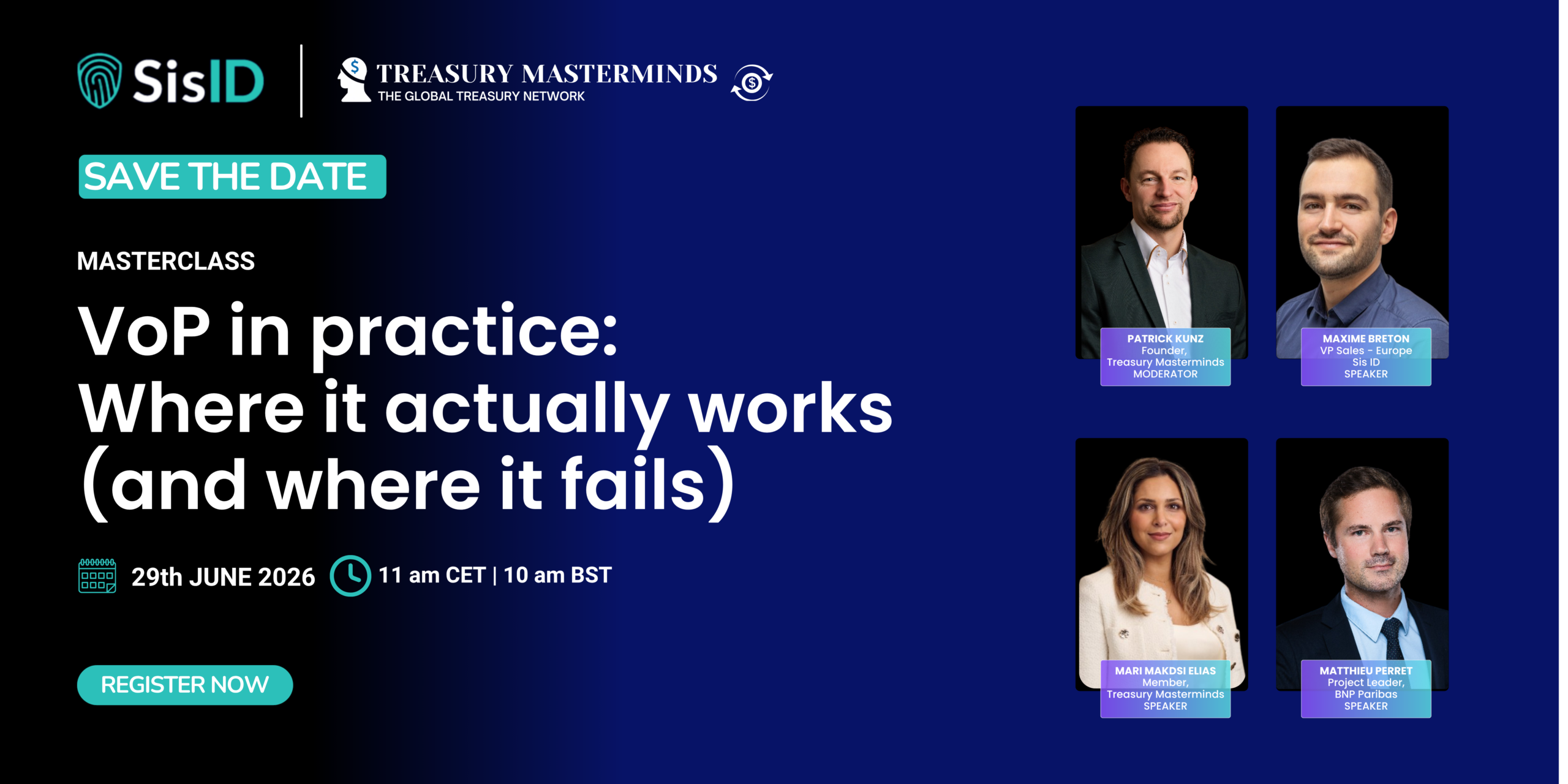
A 45-minute panel session hosted by Treasury Masterminds in partnership with SisID. Three practitioners — from banking, corporate treasury, and fintech — take a practical look at how VoP is being used today, where it falls down, and what needs to complement it.
Speakers:
Moderated by Patrick Kunz, Founder of Treasury Masterminds.
Free to attend. Click below to register and submit questions ahead of time

This article is written by Monkey
Cash flow management is critical for business success. Whether you’re a startup or an established company, implementing effective cash flow strategies can mean the difference between thriving and barely surviving in today’s competitive market.
This guide explores proven techniques to improve cash flow, recognize warning signs of cash problems, and build a stronger financial foundation for sustainable growth.
Cash flow refers to the net amount of cash moving in and out of your business over a specific period. Understanding the difference between positive and negative cash flow is essential:
Positive Cash Flow: More money coming in than going out – your business can cover expenses and invest in growth.
Negative Cash Flow: Outflows exceed inflows – putting your business at risk of financial difficulties.
Important: Cash flow isn’t the same as profit. While profit reflects earnings after expenses, cash flow measures liquidity – how much actual money you have available to operate your business.
Healthy cash flow management allows your business to:
Recognize these red flags before they become critical issues:
If you’re experiencing any of these symptoms, it’s time to implement cash flow improvement strategies immediately.
Faster collections = better cash flow. Optimize your AR with these tactics:
Invoice Immediately: Send invoices the same day you deliver goods or services. Set Clear Payment Terms: Use specific terms like “net-30” or “2/10 net-30”
Offer Early Payment Discounts: 2% discount for payments within 10 days. Implement AR Factoring: Convert receivables to immediate cash (80-95% of invoice value). Automate Follow-ups: Use software to send payment reminders automatically
While collecting payments quickly, extend your own payment deadlines when possible:
Proactive cash flow management requires regular monitoring and forecasting:
Review operating costs and eliminate waste without compromising quality:
Immediate Actions:
Ongoing Reviews:
Excess inventory ties up valuable cash. Implement these inventory optimization strategies: Just-in-Time (JIT) Ordering: Order stock as needed to minimize excess. ABC Analysis: Focus on managing high-value items more closely
Inventory Turnover Tracking: Monitor how quickly inventory sells. Seasonal Adjustments: Reduce slow-moving inventory before peak seasons
If cash flow issues stem from low profit margins, consider strategic price adjustments:
Create a financial safety net for unexpected expenses or opportunities:
Target: 3-6 months of operating expenses in reserve. Strategy: Allocate 5-10% of monthly revenue to cash reserves. Investment: Keep reserves in high-yield savings or money market accounts. Access: Ensure funds are readily available when needed
Partner with financial institutions to offer early payment options to suppliers while maintaining extended payment terms for your business.
Use excess cash strategically by taking supplier discounts when cash flow is strong and skipping them when cash is tight.
Access multiple financing options including factoring, asset-based lending, and invoice financing to optimize cash flow timing.
Track these key metrics to monitor improvement:
Operating Cash Flow Ratio: Operating cash flow ÷ Current liabilities. Cash Flow Coverage Ratio: Operating cash flow ÷ Total debt payments. Free Cash Flow: Operating cash flow – Capital expenditures Days Cash on Hand: Cash and equivalents ÷ Daily operating expenses
Mistake 1: Focusing Only on Profit
Solution: Monitor both profitability and cash flow separately – they’re different metrics
Mistake 2: Inadequate Forecasting
Solution: Create rolling 13-week cash flow forecasts updated weekly
Mistake 3: Poor Customer Credit Policies
Solution: Implement credit checks and clear payment terms from the start
Mistake 4: Seasonal Planning Failures
Solution: Plan for seasonal fluctuations and build cash reserves during peak periods
Effective cash flow management isn’t just about balancing the books – it’s about creating a solid foundation for business growth and sustainability.
Start today by:
Remember: Small improvements in cash flow timing can have dramatic impacts on your business’s financial health and growth potential.
Ready to transform your cash flow management? The combination of strategic processes, technology solutions, and proactive planning will give you the financial control needed to grow your business confidently.
Treasury Mastermind is a community of professionals working in treasury management or those interested in learning more about various topics related to treasury management, including cash management, foreign exchange management, and payments. Click below to register and connect with Treasury professionals worldwide
From Treasury Masterminds
Based on a Treasury Masterminds webinar featuring Bojan BelejkovskI, Board Member at Treasury Masterminds, and Charles Brough, VP Global Head of Account Management at SAP Taulia. Moderated by Patrick Kunz.
Recordings on Spotify and YouTube:
Working capital is one of those topics that every company talks about, but few companies truly own.
It sounds simple enough. Improve receivables. Optimise payables. Reduce trapped cash. Create more visibility. Free up liquidity.
In practice, it is rarely that clean.
Working capital does not sit neatly inside one department. Treasury sees the cash impact, procurement negotiates supplier terms, sales agrees customer terms, finance manages the accounting, operations influences execution. Everyone touches it, yet ownership is often unclear.
That was one of the key themes in our Treasury Masterminds webinar, “Unlocking Liquidity: Flexible Working Capital Strategies”, with Bojan Belejkovski, Treasury Masterminds board member, and Charles Smith from SAP Taulia.
As Patrick said during the session:
“There is no working capital department and there will never be a working capital department. Collaboration is the key.”
That may sound obvious, but it is often exactly where working capital initiatives fail.
Treasury is usually close to the numbers. It sees the cash flow forecast, the bank balances, the liquidity gaps, the funding needs and the impact of payment behaviour.
Bojan described treasury’s role very clearly:
“Treasury owns the measurement and the consequence of working capital, even when it doesn’t own the levers themselves.”
That is the uncomfortable truth.
Treasury can see that DSO is moving in the wrong direction. It can see when supplier terms create liquidity pressure. It can see when cash is trapped in entities or countries. It can also see when the forecast does not match reality.
But treasury does not always control the decisions that create the problem.
Sales may agree to extended payment terms to close a deal. Procurement may negotiate supplier terms without considering the full cash impact. Business units may sit on cash locally. By the time treasury is involved, the decision has often already been made.
Bojan put it even sharper:
“Treasury is often the last function to find out and the first one to be asked to fix something.”
Many treasurers will recognise that sentence immediately.
Visibility Comes First
Before companies can improve working capital, they need to understand where liquidity is stuck.
Charles made that point early in the discussion:
“If you don’t have visibility, you can’t actually take any action, and you can’t improve from where you are today.”
This is where many organisations still struggle.
They may have data in ERP systems, TMS platforms, spreadsheets, bank portals and local reports. The information exists, but it is fragmented. By the time it is collected, cleaned and discussed, the opportunity may already have moved.
That lack of visibility makes it difficult to answer basic questions.
Without answers to those questions, working capital management becomes guesswork. And guesswork is not a strategy, even if someone puts it in PowerPoint.
One of the most interesting parts of the webinar was the discussion about receivables.
When asked where he would focus first, Bojan did not hesitate.
“If I can fix one tomorrow, it’s going to be receivables.”
His reason was simple. Receivables are often under-owned.
Sales is focused on revenue. Credit is focused on risk. Finance is focused on accounting. Treasury is focused on cash. All of them have a role, but that does not automatically create ownership.
Or as Bojan said:
“Everyone touches receivables. No one owns it.”
That is a big issue.
A company can have a strong sales performance and still struggle with cash collection. It can have good revenue growth while liquidity gets stuck in overdue invoices. It can have a strong pipeline, while treasury is forced to deal with the cash gap.
Receivables are also messy. Customer behaviour changes. Billing data is not always clean. Collection processes are not always consistent. Commercial teams do not always want to have uncomfortable conversations with customers.
That is why receivables deserve more attention from treasury.
Not because treasury should suddenly become the collections department, nobody needs that tragedy, but because treasury can help quantify the cash impact, highlight the risk and bring the right teams together.
Supply chain finance was another important topic in the discussion.
It is sometimes presented as a simple liquidity tool. Extend payment terms, offer suppliers early payment, unlock cash. Done.
Reality is more nuanced.
Charles explained it well:
“The primary value of supply chain finance is as a negotiation tool.”
That is an important distinction.
A good supply chain finance programme is not just about creating liquidity for the buyer. It can also support suppliers by giving them access to financing at better rates than they could achieve on their own.
For the buyer, it creates flexibility. For the supplier, it can reduce cash flow pressure. For procurement, it becomes part of the broader supplier relationship.
That also means success depends on adoption.
Charles made another practical point:
“It’s not just about the rate. The supplier experience matters just as much.”
If the programme is difficult to use, suppliers will not adopt it. If procurement is not involved, it will not scale. If treasury builds the programme in isolation, it risks becoming a nice technical solution that nobody actually uses.
Bojan was clear on this as well:
“The programs that scale are the ones where procurement and treasury are genuinely aligned on day one.”
That is probably one of the most practical lessons for any company considering supply chain finance.
Do not start with the technology.
Start with alignment.
Working capital cannot be managed properly if treasury only joins at the end of the process.
Bojan captured this perfectly:
“You can’t drive strategy from the end of the process.”
If customer terms are agreed without treasury input, the cash impact becomes treasury’s problem later. If supplier terms are negotiated without considering liquidity, treasury has to manage the consequences. If local entities hold excess cash without group visibility, treasury has to work around the structure.
The companies that do this better involve treasury earlier.
Bojan explained:
“The companies where treasury drives working capital have given treasury a seat early and with a mandate.”
That mandate matters.
Treasury should not be there just to report the outcome. It should help the business understand the cash effect of decisions before those decisions are made. This does not mean treasury needs to own sales, procurement or operations. It does mean treasury should be part of the conversation when payment terms, financing structures and liquidity trade-offs are discussed.
Naturally, AI came up during the webinar. It always does now. Mention treasury technology in 2026 and AI enters the room like it owns the building.
But the discussion was refreshingly practical.
AI is not the first step.
As Patrick said during the session:
“AI is not step one. It’s often step three or four.”
Before AI can add real value, companies need visibility, automation and clean data. If the underlying data is poor, the output will be poor as well. AI does not magically fix broken processes. It just makes bad data look more confident.
Charles described the role of technology around three themes: visibility, scalability and automation.
Automation removes manual work. It makes receivables finance more scalable. It supports reconciliation. It helps treasury teams manage more with fewer resources.
Only after that foundation is in place does AI become truly useful.
Charles summarised the right mindset clearly:
“People direct. AI executes.”
That is the point.
AI should help treasury professionals gather information faster, analyse patterns and support better decisions. It should not replace judgment.
For small treasury teams, this can be powerful. Less time spent collecting data. More time spent using it.
Towards the end of the webinar, we discussed a more provocative question.
Are working capital programmes real liquidity improvements, or are they sometimes just balance sheet cosmetics?
The honest answer is: both can happen.
Some programmes are used around reporting dates to improve metrics temporarily. That may look good on paper, but it does not necessarily improve the underlying business.
Bojan was clear about that risk:
“Cosmetics are real, but they shouldn’t be the reason why you did the program.”
A well-run working capital programme should create repeatable value. It should improve liquidity, reduce funding pressure, strengthen supplier or customer relationships and give the company more flexibility.
Charles brought the discussion back to one key metric: the internal cost of cash.
If a company understands its true cost of cash, it can make better decisions about early payment discounts, supplier financing, receivables finance and liquidity trade-offs.
That is when working capital moves from cosmetic reporting to real value creation.
Working capital is not just a treasury topic: It is a business topic.
Treasury may see the problem first, but it cannot solve it alone. The real value comes when treasury, procurement, sales, finance and operations work from the same playbook.
That requires visibility.
It requires shared ownership.
It requires technology that supports the process.
And most importantly, it requires treasury to be involved before the problem lands in the cash forecast.
Working capital is often described as hidden liquidity. That is true. But in many companies, the liquidity is not just hidden in receivables, payables or trapped cash.
It is hidden between departments.
Treasury Mastermind is a community of professionals working in treasury management or those interested in learning more about various topics related to treasury management, including cash management, foreign exchange management, and payments. To register and connect with Treasury professionals, click [HERE] or fill out the form below to get more information.
This article is written by TreasuryCube
From back-office function to strategic powerhouse: How modern treasury departments are reshaping corporate finance
Corporate treasury has undergone a remarkable metamorphosis. Once relegated to the shadows of financial management—handling cash, monitoring liquidity, and mitigating basic risks—treasury has emerged as a critical strategic partner driving organizational success. This evolution isn’t merely an upgrade; it’s a complete reimagining of what treasury can and should deliver.
Today’s treasurers sit at the nexus of strategic decision-making, armed with real-time insights, predictive capabilities, and technological prowess that was unimaginable just a decade ago. As CFOs face mounting pressure to deliver value beyond traditional finance functions, treasurers have stepped up to become indispensable strategic advisors.
Organizations hesitating to modernize their treasury functions face existential risks in today’s volatile business landscape:
As one Fortune 500 treasurer recently noted: “Our transformation journey wasn’t optional. It was either evolve or become obsolete.”
The marriage of digital technologies with treasury operations has created unprecedented efficiencies. AI and ML algorithms now predict cash positions with remarkable accuracy, while RPA has eliminated manual processes that once consumed thousands of labor hours annually.
Consider the impact: One global manufacturer reduced payment processing time by 87% through intelligent automation, freeing their treasury team to focus on strategic initiatives that generated over $12M in additional working capital.
Treasury transformation has been significantly advanced by innovative TMS providers like TreasuryCube. As a comprehensive corporate treasury management software, TreasuryCube helps companies manage their cash, liquidity, risk, and investments with exceptional efficiency. Built on the latest .NET framework and utilizing web assembly technology, this SaaS platform offers:
The explosion of financial data has transformed treasurers from backward-looking reporters to forward-thinking strategists. Advanced predictive models now forecast cash positions with precision while identifying anomalies that might signal fraud or operational issues.
Real-time dashboards have replaced monthly reports, enabling treasurers to:
TreasuryCube exemplifies this trend with its comprehensive reporting and analytics capabilities, including customizable dashboards and automated report generation that enable companies to monitor financial performance, identify trends, and make data-driven decisions.
As regulatory frameworks grow increasingly complex—from Basel III to IFRS 9 to expanding ESG mandates—treasurers have evolved sophisticated compliance capabilities. Treasury transformation has enabled organizations to navigate this complexity with remarkable precision.
Modern treasury management systems like TreasuryCube ensure adherence to internal and external regulatory requirements, such as anti-money laundering (AML) and know-your-customer (KYC) guidelines, while incorporating robust security measures to protect sensitive financial data.
ESG considerations have moved from peripheral concerns to central treasury priorities. Forward-thinking treasurers are now:
The migration to cloud-based treasury management systems represents more than a technology shift—it’s a fundamental reimagining of how treasury functions operate. TreasuryCube embodies this evolution as a genuine multi-tenant Software-as-a-Service platform that offers:
As a cloud-native solution, TreasuryCube eliminates the need for extensive implementation timelines with highly configurable workflows and prebuilt master data upload capabilities, reducing consulting and implementation hours significantly.
The API revolution has unleashed unprecedented connectivity between treasury systems, banking partners, and third-party platforms. TreasuryCube leverages this technology with custom connections to both internal and external data sources, ensuring that no matter which solutions or services a company utilizes, their data is always available for visualization, analysis, and reporting.
This connectivity enables:
As treasury operations digitalize, cybersecurity has evolved from IT concern to treasury imperative. Leading treasury management systems like TreasuryCube utilize enterprise-grade security measures, including:
Innovative treasurers have transformed working capital management from a financial necessity to a competitive advantage. TreasuryCube enhances this capability by optimizing receivables, payables, and inventory management through:
The relationship between corporate treasury and FinTech has evolved from competitive to collaborative. TreasuryCube exemplifies this trend by delivering specialized financial software development services that create secure and reliable IT ecosystems for treasury departments.
This approach enables treasurers to:
Perhaps most significantly, the profile of treasury professionals has fundamentally changed. Today’s high-performing treasury teams blend:
TreasuryCube supports this evolution by providing intuitive, user-friendly interfaces that are built on modern technology frameworks, enabling treasury professionals to focus on strategic activities rather than manual processes.
The trajectory is clear: tomorrow’s treasury function will serve as the strategic command center for organizational financial performance. With solutions like TreasuryCube leading the way, we can expect:
As TreasuryCube’s approach demonstrates, this evolution is not just about technological advancement—it’s about empowering financial decisions with real-time insights and seamless automation that drives business value.
Corporate treasury transformation represents more than modernization—it signifies the transcendence of traditional financial boundaries. The treasury function is evolving from a processing center to a value creator, from a risk mitigator to an opportunity enabler, from a cost center to a strategic advantage.
Advanced treasury management systems like TreasuryCube are at the forefront of this evolution, providing the technological foundation that enables treasurers to deliver strategic impact. With features ranging from cash flow positioning and forecasting to intercompany netting and seamless accounting integration, these systems are redefining how treasury departments operate.
Organizations that embrace this transformation journey position themselves not just for financial efficiency but for market leadership. In a business environment characterized by volatility and disruption, a transformed treasury function—supported by innovative technology solutions—becomes the financial north star, guiding the organization through uncertainty with clarity, confidence, and strategic purpose.
The question is no longer whether treasury transformation is necessary, but whether your organization will lead or follow in the race to reimagine what treasury can achieve.
Treasury Masterminds is a community of professionals working in treasury management and those interested in learning more about topics such as cash management, foreign exchange management, and payments. To register and connect with Treasury professionals, click [HERE] or fill out the form below to get more information.
Join Treasury Masterminds and Trustpair for a masterclass on the practical implementation of VoP, including its limitations—such as geographical restrictions, limited checks, and its late position in the payment chain. Discover why comprehensive fraud prevention solutions like Trustpair go beyond VoP and are essential for safeguarding your organization throughout the entire payment process.
We hosted the one and only Summa Simmons, also known as the “Cash Queen,” Associate VP of Global Treasury at Victoria’s Secret & Co., seasoned finance strategist, and champion for diversity and inclusion. In this episode, we’ll dive deep into treasury innovation, leadership lessons from retail treasury, and why inclusion truly matters for building high-performing teams. But it wasn’t all serious—we also explored some treasury “Netflix plots” and found out exactly why Summa earned her title as the “Cash Queen.”
Join Treasury Masterminds and Kyriba for a webinar exploring the most impactful trends shaping treasury and financial management today. Our expert panel will share insights to help finance leaders prepare for what’s next—and seize new opportunities.
Join Treasury Masterminds and Embat in this insightful webinar, where our expert panel explores practical, real-world applications of AI. We will cut through the buzz to reveal how AI effectively addresses daily operational pain points, empowering finance teams like never before.
“Behind the Mic with Eleanor Hill—The Voice of Treasury Stories” What happens when two treasury podcasters sit down for a live, unscripted conversation? Join us as I speak with Eleanor Hill, founder of TreasuryStoryteller.com, for a special debut episode of TreasuryMasterminds: Mastering Treasury Together Podcast.
Our experts will delve into insights from Trustpair’s UK Fraud Study, highlighting why organizations are struggling to detect and prevent fraudulent activities effectively. Discover how emerging AI-driven threats and evolving cyber fraud tactics are leaving even the most diligent teams vulnerable, and learn the steps you can take to safeguard your organization.
Choosing the right Treasury Management System (TMS) is one of the most impactful decisions a treasury team can make. With countless options on the market and rapidly evolving technology, how do you identify the solution that truly meets your organization’s needs? Join us for an engaging discussion featuring industry experts who will share actionable insights and real-world experiences to help you navigate the TMS selection process.
We conducted a comprehensive survey, engaging treasury professionals from various sectors to explore how AI is currently being utilized, the key opportunities and threats it presents, and where participants believe the future of AI in treasury is heading. The insights we’ve gathered are not just fascinating—they’re a window into how technology is reshaping the way treasury functions at both strategic and operational levels.
We are excited to sit down with Emma West, the driving force behind one of the world’s most influential finance events—EuroFinance.
Emma’s career spans prestigious names like the Financial Times and The The Economist Group, but her path to becoming a leader in the treasury and payments space is as fascinating as the events she curates.
Join us for a special episode of the Treasury Masterminds podcast featuring Meticulous Tendai Dube, a seasoned treasury professional who has led teams across Africa and the Middle East.
Join us for a fresh take on treasury with Pavlos Panagitsas, Junior Treasury Analyst at Avramar, ESG enthusiast, and founder of ESG news platform ESGenre.
We hosted the one and only Summa Simmons, also known as the “Cash Queen,” Associate VP of Global Treasury at Victoria’s Secret & Co., seasoned finance strategist, and champion for diversity and inclusion. In this episode, we’ll dive deep into treasury innovation, leadership lessons from retail treasury, and why inclusion truly matters for building high-performing teams.
“Behind the Mic with Eleanor Hill—The Voice of Treasury Stories” What happens when two treasury podcasters sit down for a live, unscripted conversation? Join us as I speak with Eleanor Hill, founder of TreasuryStoryteller.com, for a special debut episode of TreasuryMasterminds: Mastering Treasury Together Podcast.