This article is written by Nomentia
In an engaging opening address, Nomentia’s own Lauri Bergström and Tapani Oksala painted a vivid tableau of the ever-evolving landscape of treasury management and Nomentia’s customer-centric and dynamic approach to its developments. Three key trends emerged as focal points: financial strategy, risk management, and technological advances. Emphasizing the critical role of teamwork and leadership across organizations, the duo set up a robust foundation for the summit’s discussions.

The event kicked off in full with a deep dive into the complexities of liquidity management, as exemplified by Caverion’s finance operations amidst a strategic merger. In this session, Viljami Vainikka, Head of Group Treasury at Caverion, provided a comprehensive overview of Caverion’s liquidity landscape during a merger with Assemblin, highlighting their approach to optimizing cash visibility and addressing challenges in cash flow forecasting. He outlined Caverion’s liquidity management setup, which includes cash management across multiple currencies, numerous bank accounts, and entities, with a focus on optimizing liquidity and improving forecast accuracy.

In conversation with Tapani Oksala, Vainikka shed light on the challenges of optimizing cash visibility and underscored the importance of robust and accurate cash forecasting, leveraging technology and strategic partnerships, and the potential for integrating AI to enhance liquidity planning processes to increase efficiency and accuracy.
In the second presentation of the Nomentia Treasury Summit, Dirk Schreiber, Head of Treasury at BioNTech, shared with the audience insights into BioNTech’s journey amidst the centennially turbulent times leading toward the COVID-19 pandemic and its aftermath.

Founded in 2008, BioNTech experienced initial challenges until the onset of the COVID-19 pandemic in early 2020. Recognizing the potential of their mRNA technology for developing a COVID-19 vaccine, BioNTech swiftly pivoted its focus, leading to the rapid development and distribution of a vaccine in collaboration with Pfizer.
Schreiber highlighted the unprecedented growth and financial influx that followed the successful vaccine development, presenting BioNTech’s treasury management journey in response to these dynamic circumstances. With a surge in funds, BioNTech urgently required a robust treasury management system to manage its expanding financial operations. Despite facing initial challenges with an untested treasury function, Schreiber and his team swiftly implemented a treasury management system, leveraging Nomentia’s expertise to build BioNTech’s treasury operations.
The presentation explored the intricacies of BioNTech’s treasury transformation, emphasizing the rapid expansion of requirements for the treasury and the establishment of essential treasury guidelines and processes for future development. Schreiber emphasized the critical role of the right technology in this transformation, particularly the implementation of Nomentia’s treasury management system to provide real-time visibility into cash positions, automate trading activities, and streamline reporting processes.
The panel discussion featuring representatives from Nordea, SEB, and OP shed light on the evolving landscape of financial crime prevention and the role of banks as strategic partners.

Against the backdrop of increasing cybersecurity threats, the panel emphasized the importance of collaboration between banks and corporate treasuries in combating financial crime.
As technology evolves, it brings with it new and exciting opportunities to those companies that are able to manage their risk appetite accordingly. Unfortunately, the development of technology also provides opportunities to the criminal element. The threat landscape in the digitalized business environment is significantly more complex than before. Thanks to technology we’re living in an environment wrought with crime and fraudulent behavior. The ecosystem of crime in the digitalized financial environment is complex and ever more susceptible to human error and poor processes.
The panel’s discussions centered on the adoption of innovative technologies and best practices for enhancing security and mitigating risk in treasury operations. This session focused on the crucial role of proactive measures and strategic partnerships in safeguarding financial assets in an increasingly digital world.
According to the panel, treasury management and financial professionals would do well not to treat the fight against financial crime as a digital problem only, as the evolving threat landscape requires an adaptive and nimble approach not only to security technology but the organizational culture as well.
Fortunately, this is not a fight that businesses have to face on their own. The banking and finance industry has taken proactive steps to improve its resilience and business continuity.
On the legislative side, the EU’s DORA (Digital Operations Resilience Act) is a great example of how demands for businesses to secure their operations in the financial threat landscape is not only a digital undertaking but requires a wider scope that encompasses their operations fully.
In the 4th presentation of the day, Stefan Müller from Eaton discussed the digitalization of bank account management (BAM) during the Nomentia’s Treasury Summit. Previously, BAM was cumbersome and fragmented, involving manual tasks, email exchanges, and Excel spreadsheets. Eaton recognized the inefficiencies and partnered with Nomentia in 2019 to modernize their BAM processes.
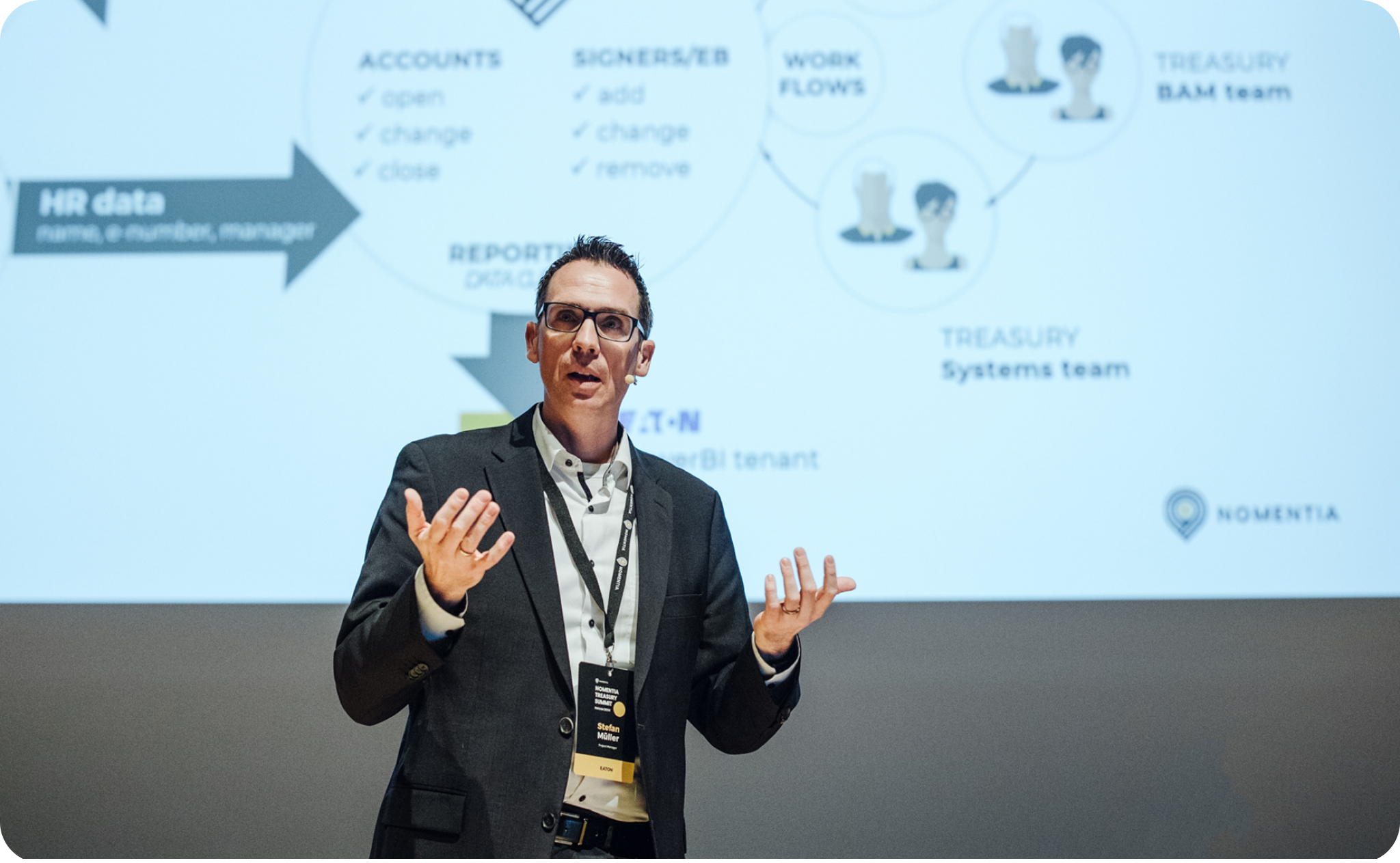
The transformation involved leveraging advanced digital technologies to automate tasks like account openings, closures, signatory changes, and transaction monitoring. This shift required comprehensive cleanup of account and signer data, process documentation, and target workflows. By mid-2021, the project was underway, and by March 2022, the new BAM system was live.
Today, Eaton manages BAM operations on one centralized platform, gaining efficiency, control, and compliance. Automated reconciliations and streamlined workflows have reduced manual efforts significantly. The treasury function has seen tangible benefits, including the closure of 200 accounts and the removal of over 200 signers and 2,300 permissions.
The digitalization of treasury operations has offered opportunities for greater control and efficiency. Real-time data access enables informed decision-making and proactive risk management. Automation of routine tasks frees up time for strategic analysis. However, increased reliance on digital platforms necessitates robust security protocols to mitigate cybersecurity risks.
Karin Wahlgren’s presentation on SKF Group’s global payment transformation journey provided a glimpse into the realities of treasury management.
By embracing automation and strategic decision-making, SKF Group transitioned from manual to automated payment processes, achieving significant efficiencies and cost savings. 
The success story of SKF Group underscores the transformative impact of technology on global payments, offering valuable lessons for organizations seeking to enhance their treasury operations. Wahlgren’s insights into strategic decision-making and project management underscored the importance of leadership and innovation in driving treasury transformation initiatives.
The fifth presentation of the day offered an intriguing exploration into the cash flow forecasting processes on a state treasury level. The talk provided a unique perspective on national financial stability. By employing sophisticated tools and techniques, State Treasuries ensure sufficient cash reserves to meet the country’s financial obligations in all situations. The presentation highlighted the critical role of treasury management in safeguarding national financial interests, underscoring the importance of rigorous planning and preparedness.
In the final talk of the day, Hubert Rappold, Chief Sales Officer at Nomentia, delivered a thoughtful keynote address emphasizing the evolving role of treasury teams in the digital era.

Despite the traditional focus on liquidity management and risk mitigation, technological advancements are reshaping treasury operations. While there’s a tendency to overemphasize the immediate impact of emerging technologies, it’s crucial to maintain a realistic perspective, considering both short-term expectations and long-term implications. Drawing parallels with the Gartner Hype Cycle, Rappold highlighted the trajectory of technologies like AI, emphasizing the need for a balanced understanding of their capabilities.
Advanced technologies such as AI, machine learning, and natural language processing offer significant potential for enhancing decision-making processes and streamlining workflows in treasury operations. However, it’s essential to prioritize efficiency and accuracy, leveraging real-time data for strategic initiatives like liquidity management and risk mitigation. As treasury functions evolve, professionals assume a more strategic role, contributing to overall business growth by driving innovation and leveraging advanced technologies.
Treasury Mastermind is a community of professionals working in treasury management or those interested in learning more about various topics related to treasury management, including cash management, foreign exchange management, and payments. To register and connect with Treasury professionals, click [HERE] or fill out the form below to get more information.

By Alexander von Schirmeister,
CEO at Nomentia
A bank portal still works. The ERP still produces data. A spreadsheet still calculates a forecast. A payment approval workflow still moves from one person to the next. Reports still reach the CFO, even if they arrive later than expected. From the outside, treasury appears to function. Inside the process, finance teams know exactly how much effort is required to keep that appearance of control intact.
Modern treasury cannot rely on disconnected systems because the questions it needs to answer are no longer isolated. Cash visibility depends on bank data, account structures, ERP information, payments in progress, forecast inputs, intercompany flows, financing activities, and exposures. Liquidity planning depends on operational data from the business, but also on treasury assumptions, market conditions, working capital movements, and funding plans. Risk management depends on reliable exposure data, but also on trade execution, hedge documentation, limits, reporting, and accounting. If each part of this picture sits in a different place, the treasury team becomes the integration layer.
That integration work rarely surfaces. It lives in copy-and-paste routines, manual file checks, email reminders, reconciliation notes, spreadsheet tabs, and individual memory. It is also where most treasury management challenges quietly begin.
Disconnected systems create time loss because data has to be gathered before it can be analysed. They create duplicated work because teams maintain local trackers even when central tools exist. They weaken cash visibility because the latest view may depend on which bank file has arrived or which entity has responded. They weaken controls because exceptions are harder to identify when workflows are not connected.
The CFO does not usually see the process friction. The CFO sees the answer. If the answer is late, inconsistent, or hard to explain, confidence falls. Senior leadership needs reliable responses to simple but high-stakes questions: How much liquidity is available? Which cash flows are expected? Where is working capital tied up? Are internal payments efficient? Which exposures are material? Are guarantees, hedges, and commitments under control? These questions cannot be answered well when the data behind them has to be rebuilt every time.
The 2026 Nomentia Treasury and Cash Management report highlights that many treasury teams are in a transitional phase. They have moved beyond purely manual treasury, but still rely on multiple systems and partial automation. The pattern is familiar: the organisation has invested in technology, yet treasury still spends too much time reconciling information and validating reports. The issue is not that systems are missing. The issue is that they are not connected enough to support the pace of decision-making.
Disconnected systems are especially risky in three areas.
The first is visibility. If cash positions, transactions, forecasts, and payment statuses are not consolidated, treasury may see parts of the picture but miss the direction of movement. A balance report can show where cash is today, but it does not explain whether the position is temporary, restricted, exposed, or needed elsewhere in the group. Visibility without context can create false comfort.
The second is control. Treasury policies often look clear on paper, but control depends on how processes actually run. Who can approve a payment? Which entities have followed the forecast process? Which exposures have been validated? Which guarantee is close to expiry? Which hedge relationship needs attention? When workflows are disconnected, control becomes dependent on manual follow-up. That may work when volumes are low, but it becomes unreliable as banks, entities, instruments, and reporting expectations increase.
The third is decision speed. In volatile markets, delayed answers are not neutral. A late forecast can affect funding decisions. A delayed exposure view can affect hedge timing. A slow payment status check can affect supplier confidence. A late view of guarantees or credit line usage can affect working capital decisions. Treasury does not need real-time data for every decision, but it does need enough connected information to avoid making decisions with yesterday’s understanding.
A modern treasury management system should not be judged only by feature breadth. The more important question is how well it reduces the gaps between systems, data, workflow, and reporting. A strong setup connects bank information, ERP data, payment processes, cash forecasting, risk workflows, analytics, and audit trails into a reliable operating model. That does not mean every company needs every module at once. It means the architecture should support growth without forcing the team to rebuild its processes every time complexity increases.
Most people researching a TMS today will start with a web search or ask Copilot, Gemini, or ChatGPT. The answer they get back is usually a feature list. That’s not wrong, but it’s incomplete. A good treasury management system helps finance teams centralise cash, payments, forecasting, risk, controls, and reporting so they can make better liquidity and financial risk decisions with trusted data. Features are how it gets there. That’s the distinction worth keeping in mind when evaluating whether your current setup is still fit for purpose.
The path away from disconnected systems does not always require a large replacement project. In many organisations, the better approach is to identify the most painful manual bridges first. Where does treasury re-enter data? Where does the team wait for local input? Where do reports need manual explanation? Where are approvals outside the system? Where is the same number calculated in different ways? These questions show where fragmentation is creating the most business risk.
Connected systems create reliable answers. They reduce the manual work behind cash visibility, improve the quality of cash flow forecasting, and support stronger controls and compliance. They help the CFO understand not only what the numbers are, but what they mean for liquidity, risk, and action. Disconnected systems may still function. But they make treasury work harder than it should, and confident decisions harder than they need to be.
Treasury Masterminds is a community of professionals working in treasury management or those interested in learning more about various topics related to treasury management, including cash management, foreign exchange management, and payments. To register and connect with Treasury professionals, click the button below.