This article is written by Nomentia
Your cash flow forecast is lying to you. Not on purpose, but it’s wrong—probably by a lot. Spreadsheets lull you into a false sense of control, but the numbers lie. They miss shifts in spending, overlook delayed payments, and crumble the moment reality deviates from last month’s assumptions. By the time the cracks show, you’re already scrambling—plugging holes, chasing down cash, and making desperate decisions.
Hubert Rappold works as a Senior Treasury Expert at Nomentia, bringing his over 20 years of expertise to serving Nomentia’s customers’ treasury needs and challenges in payments, cash visibility, and forecasting.


Johannes Pöschl is a Senior Data Scientist at Nomentia, specializing in predictive analytics and AI-driven cash flow forecasting solutions.
A cash flow forecast that’s even slightly off can send your business into a tailspin. As Hubert Rappold puts it: “Small deviations in cash flow forecasts can lead to big financial risks.” Underestimate expenses, and you’re suddenly short on cash when payroll hits. Overestimate revenue, and you’re making spending decisions based on money that isn’t actually there. “Basing your decision on a forecast that is substantially off; you might end up making decisions based on inaccurate data—like borrowing unnecessarily or mismanaging liquidity.” The further your forecast drifts from reality, the riskier every financial move becomes. And in a world where margins are tight, customers pay late and surprises lurk around every corner; imprecise forecasting isn’t just an inconvenience but a liability.
At its core, cash flow forecasting is just this: predicting how much money will move in and out of your business over a given period. It’s not about spreadsheets or fancy formulas but knowing, with as much certainty as possible, whether you’ll have enough cash to cover what’s coming.
Most businesses, big and small, still rely on outdated tools and methods that weren’t built for today’s financial landscape. Here’s why they fail:
Let’s be clear—treasurers and finance managers are some of the most skilled problem-solvers in any business. They know how to fine-tune their forecasts, clean up messy data, and make Excel do what they need. But time is limited, and expectations keep rising. The demand for instant, up-to-date cash visibility means they can only do so much, no matter how skilled they are.
“Excel-based forecasting worked perfectly fine when business environments were more predictable,” explains Johannes Pöschl. “But today, cash flows are influenced by a web of factors—seasonality, economic shifts, even supplier behavior. Static spreadsheets just can’t keep up with that complexity.”
And here’s the real danger: many forecasts depend entirely on the person who built them. If that expert is unavailable—whether they leave, take a vacation, or simply get swamped—no one else knows exactly how their formulas and models work. That’s a terrifying prospect for any company relying on accurate cash flow predictions.
This is where AI-driven automation changes the game. Instead of a fragile, human-dependent system, businesses get a dynamic, always-updating forecast that adjusts in real time. It doesn’t replace the finance team—it gives them superpowers. Let’s take a look at:
For many, forecasting cash flow, is a reactive scramble. No wonder, when traditional forecasting relies on static models and best guesses. Implementing AI into your forecasting you can go beyond static formulas and outdated assumptions. Not just automate your forecasting, but make it smarter, spot hidden patterns and continuously refines projections.
“AI forecasting can lead to more objective forecasts, leaving behind the impact of regional optimism biases in forecasting,” says Johannes. “They can also incorporate resource prices and estimate their effects on supplier prices that traditional models or treasurers might miss.”
As Hubert adds: “AI can automatically classify transactions from bank statements, showing finance teams exactly where cash flow discrepancies are coming from—late customer payments, unexpected supplier costs, or seasonal trends. That kind of insight is invaluable.”
Here’s how it stacks up against traditional methods:
| Traditional forecasting methods | Challenges for forecast accuracy | AI in forecasting: Key techniques for accuracy improvement |
| Manual data entry & spreadsheets | Prone to human error, delays, and data inconsistencies | Automated connectivity & forecast reconciliation: integrating real-time bank & ERP data to eliminate errors and update forecasts dynamically. |
| Rule-based forecasting (fixed models) | Rigid assumptions fail to capture real-world volatility | Machine learning & pattern recognition: AI-powered forecasting learns from past errors and adapts dynamically to new trends. |
| Historical trend extrapolation | Fails to account for sudden economic shifts, external shocks | Multi-variable analysis: AI-driven forecasting incorporates economic indicators, market trends, and business-specific variables. |
| Limited scenario planning | Forecasts become unreliable in times of uncertainty | Risk simulations & stress tests: AI forecasting can run multiple scenarios to assess financial resilience under various conditions. |
| Static payment terms-based Cash flow predictions | Overlooks customer-specific behavior, which leads to inaccurate receivables forecasts | Dynamic payment behavior predictions: AI forecasts can analyze past payment trends to predict late payments with higher accuracy. |
| Isolated departmental forecasting | Fragmented cash flow data across finance, treasury, and operations | Automated connectivity: Forecasts integrate multiple data sources for a holistic, real-time view of liquidity. |
| Lack of external market consideration | Ignores macroeconomic trends, FX rates, inflation, and geopolitical risks | Sentiment & market trend analysis: AI-supported forecasts process can incorporate market sentiment indices, GDP forecasts, interest rates and other data affecting the business environment to refine forecasts. |
| Reactive forecast adjustments | Adjustments are made after discrepancies occur, not proactively | Self-learning algorithms: continuous refinement of forecasts based on real-time variance analysis. |
| Delayed cash flow reconciliation | Forecasts deviate from reality due to mismatches in receivables/payables data. | Automated invoice matching & forecast reconciliation: reconciling forecasts against actual bank transactions in real-time. |
“Take something as simple as public holidays,” says Johannes. “They affect cash flows differently depending on the industry and country, and AI can model these effects automatically. Over time, the system refines itself, making forecasts even more accurate.”
Hubert gives another example: “AI can analyze past customer payment behaviors to refine expected due dates. But even simple logic—like applying Days Sales Outstanding (DSO) metrics—can significantly improve accuracy, especially for short-term forecasts.”
Let’s consider:
Every morning, the Treasurer of a globally operating business opened the same monster Excel file—a tangled web of formulas, manual inputs, and linked sheets that somehow held the key to the company’s cash flow. Keeping it updated was a full-time job. Data trickled in from subsidiaries across time zones, bank accounts were scattered across multiple institutions, and assumptions had to be constantly tweaked. Forecasting was supposed to provide clarity, but instead, it felt like a high-stakes guessing game.
The demands from leadership kept growing: More accuracy. More real-time visibility. More risk mitigation. But with what? The Treasurer had already pushed Excel to its limits, building an intricate system that only they truly understood. When the CFO needed answers, they delivered—but not without late nights, countless emails chasing missing numbers, and a nagging fear that one small mistake could throw everything off.
Then came the talk about AI-powered forecasting.
It sounded promising—automation, real-time data analysis, better predictions. But there was also an unspoken worry: What if this replaces me? What if all my expertise, my hard-earned knowledge, gets sidelined by software?
And yet, the bigger fear wasn’t AI. It was this. This endless cycle of manual work, desperate fixes, and hoping that when leadership asked for insights, the numbers weren’t off—because if they were, it would be their name on the line. Worse still, if they ever stepped away, who else would even know how to keep this monster running?
That’s when the real question hit: What’s the bigger risk—adopting AI or continuing like this? Spending hours babysitting spreadsheets?
The reality hit. So they ran the numbers. Even a small boost in forecast accuracy would cut emergency borrowing and save more than enough to justify the investment. The business case was clear. It was time to kill the spreadsheet before the spreadsheet killed them.
“A lot of treasurers worry that AI will replace them,” Johannes notes. “But in reality, AI is just a tool—it provides forecasts, but treasurers still bring the expertise to validate and interpret them. The most successful teams use AI to eliminate tedious manual work, freeing themselves to focus on strategy.”
Hubert agrees: “If you set up AI-driven forecasting right, you don’t just improve accuracy—you make life easier. Treasurers get instant feedback, can compare past forecasts to actuals, and refine their approach over time. The goal isn’t to replace them; it’s to give them better tools.”
You wouldn’t steer a company based on gut feelings alone—so why accept guesswork in cash flow forecasting? AI isn’t a magic fix, but it’s the difference between informed decisions and financial blind spots. The real risk isn’t AI—it’s sticking to spreadsheets while the world moves forward.
Treasury Masterminds is a community of professionals working in treasury management or those interested in learning more about various topics related to treasury management, including cash management, foreign exchange management, and payments. To register and connect with Treasury professionals, click the button below.
This article is a contribution from our partner, Embat
Accounting with the best financial team is a critical factor of success for any business, so nothing is more important for the CFO than surrounding themselves with the right people, this is what will allow you to enhance your role and focus on value generation from a much more strategic than operational perspective.
Traditionally, the financial domain was characterised by the mastery and application of a series of technical knowledge, which when well used not only allows one to ‘explain the past’, but also to generate reliable information for business decision making thus minimising the risk of errors.
It is the advance of technology itself, which has allowed them to redefine their role, following the same line of evolution as that of the CFO themselves, that is, towards a vision much more focused on the company’s business and strategy and not merely focused on explaining what has happened and on regulatory compliance.
This reconversion of the area requires the need for professional profiles that not only have a solid “technical” knowledge, but also have the necessary skills to take advantage of the benefits offered by the new technologies available.
It is above all a change in the culture of the area that must accompany and support the evolution of the business itself, adopting new ways of working, based on collaboration, experimentation and continuous learning, while at the same time requiring a rethinking of the operating model, including the automation of tasks and the redefinition of internal processes.
Combining analytical rigor with business intuition, technical precision with the flexibility to adapt to changes in the environment, is essential when it comes to building a financial team, where technical expertise becomes a necessary (and mandatory), but not sufficient, skill.
It is therefore necessary for financial professionals to have a broader understanding of the business they manage, in order to be able to adapt as quickly as possible to changes, which are becoming faster and faster.
The evolution of the CFO in today’s business strategy
Discover the evolution of the CFO and their relevance in today’s business landscape.
Being able to translate and being able to communicate complex information in such a way that it can be used for decision making by the rest of the organisation, which generally speaks a different ‘language’ and does not usually have the same technical knowledge, requires the development and good application of what are defined as ‘soft skills’.
Empathy, proactive attitude, autonomy, thinking critically about how things are done, adapting to new scenarios, interacting with interdepartmental teams, are critical and essential skills that any finance team must have in order to turn data into analysis, business opportunities into results and strategy into profitability for the company.
This is where the CFO takes on a central role, in the sense of being able to integrate the different skills of the financial team, identifying both their strengths and weaknesses, thus ensuring that all members of the team work towards the same common goal.
Therefore, it becomes relevant to promote diversity within the financial team not only in terms of the incorporation of people with different professional experiences, but also with other ways of thinking and approach, in order to encourage the generation of innovative ideas that can become creative solutions to the problems that arise.
A diverse finance team can also be better prepared to meet the challenges of a globalized marketplace. Companies operating in multiple countries need teams that understand the particularities of each region, both from a technical and cultural perspective.
On the other hand, it is necessary to promote a culture of open and ‘bidirectional’ communication between the CFO and the members of their team, where the contributions of each one of them are valued, something that is relevant to strengthen the group and thus tend to achieve the proposed objectives.
Trust is another essential requirement for building a cohesive team, especially when confidential and strategic information must often be managed, which is why it is essential to guarantee its integrity. Likewise, it must be bidirectional, thus generating a climate of security that reinforces open communication, as well as the responsible assumption of risks and the ability to learn not only from the successes achieved, but also from the failures.
Thus, forming a financial team is a process that requires a certain “science” in the selection of the best talents with the necessary technical knowledge for the development of their functions, as well as the purest “art”, since it must be complemented with the ability to adapt, innovate and collaborate closely with other areas of the company.
In this way, a balanced integration between art and science is what really determines the difference between a financial team that is oriented to the administration of resources, and another that is dedicated to the generation of value through continuous improvement.
Treasury Masterminds is a community of professionals working in treasury management or those interested in learning more about various topics related to treasury management, including cash management, foreign exchange management, and payments. To register and connect with Treasury professionals, click the button below.
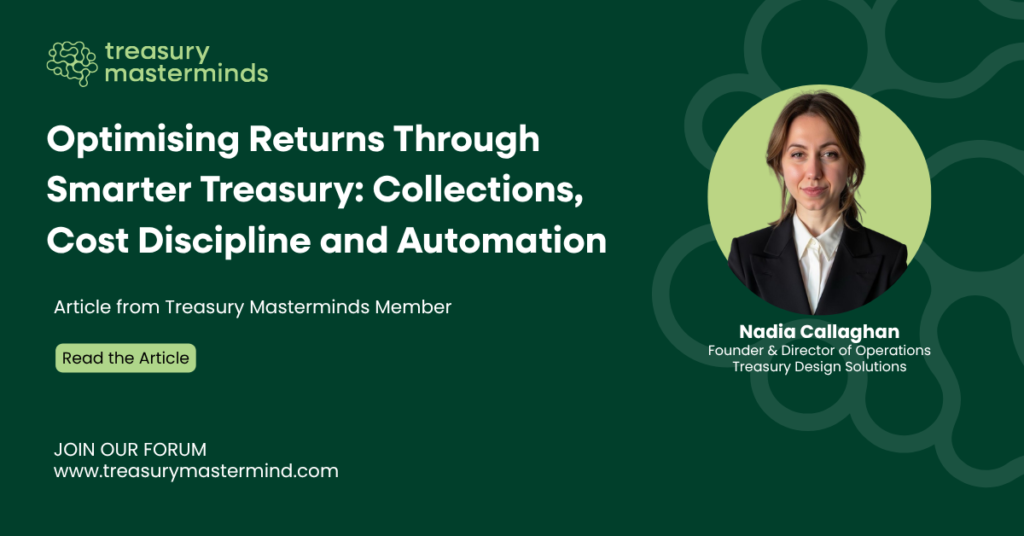
This article is written by Nadia Callaghan
Treasury has quietly become one of the most powerful levers for improving financial performance. In many organisations, it is still treated as a protective cost-centre function, focused on liquidity, compliance and risk management. Yet the businesses that outperform today are those that recognise treasury as a value creator. From my experience, optimising finance returns is not only about taking more risk; it is also about tightening the fundamentals that determine how efficiently money moves through the organisation.
The first and most immediate source of value comes from strengthening collections. Cashflow improves dramatically when organisations collect what they are owed, when they are owed, without leakage or delay. Accounts receivable often suffers from fragmented ownership, inconsistent follow‑up and manual allocation processes that slow everything down. Commission collections can be even more complex, especially in industries where revenue is shared across multiple parties. When treasury leads a disciplined approach to collections, supported by real‑time ageing visibility, automated reminders and clear accountability, liquidity improves almost instantly. Faster allocation of incoming cash reduces unapplied balances, improves forecasting accuracy and frees capital that would otherwise sit idle.
Cost discipline is the second major lever. Operating expenses are rarely fixed; they simply feel that way because they are not reviewed often enough. Treasury can materially improve returns by treating bank fees and partner contracts as commercial agreements rather than administrative necessities. Regular fee reviews reveal charges for services no longer used, pricing tiers based on outdated volumes and FX or payment fees that are significantly above market rates. Debt‑side partner contracts often contain renewal clauses, utilisation fees or covenant‑related costs that can be renegotiated when treasury brings data to the conversation. Organisations that review these agreements quarterly typically achieve meaningful cost reductions without changing their operating model.
Once collections tighten and costs come under control, surplus liquidity becomes visible. Idle cash is one of the most common drags on returns, and yet it is also one of the easiest to fix. Treasury can deploy surplus funds into safe, yield‑generating instruments such as money market funds, notice accounts, term deposits or custody accounts for short‑term securities. These options provide daily liquidity, low risk and significantly better returns than traditional operating accounts. Even modest yields create meaningful profit when applied to large balances that previously sat dormant.
Centralising liquidity amplifies these gains. Cash pooling allows organisations to treat group‑wide cash as a single strategic asset rather than a collection of isolated balances. Physical pooling sweeps cash into a master account, reducing external borrowing and enabling centralised investment strategies. Notional pooling aggregates balances virtually, optimising interest without the complexity of intercompany loans. Both approaches reduce reliance on external debt, lower interest expense and increase the organisation’s ability to generate returns from its own liquidity.
The final lever is automation, which is often underestimated in its impact. Manual treasury processes consume time, introduce errors and prevent teams from focusing on value‑creating activities. Automating bank reconciliations, AR allocation, commission matching, payment runs, forecasting and intercompany settlements reduces operating costs and strengthens control. Automation also improves data quality, which in turn improves decision‑making. Treasury teams that operate with clean, real‑time data can model scenarios more accurately, anticipate liquidity needs earlier and respond to market conditions faster.
Optimising returns is not a single initiative; it is a discipline. When treasury strengthens collections, reviews expenses with commercial rigour, deploys surplus cash intelligently, centralises liquidity and automates manual processes, it becomes a profit engine rather than a cost centre. The organisation benefits from improved cashflow, reduced leakage, lower operating costs and higher returns on liquidity. Treasury’s role shifts from safeguarding the business to powering it, creating a financial foundation that supports growth, resilience and strategic ambition.
Treasury Masterminds is a community of professionals working in treasury management or those interested in learning more about various topics related to treasury management, including cash management, foreign exchange management, and payments. To register and connect with Treasury professionals, click the button below.
This article is a contribution from our content partner, Kyriba
There is a quiet revolution happening inside the world’s most forward-looking finance organizations, and most treasury teams are watching it from the hallway. Artificial intelligence is no longer a pilot program, a buzzword in a vendor deck, or a problem for IT to solve. Treasury AI adoption is actively reshaping how cash is managed, how risk is quantified, and how financial leadership earns its seat at the strategic table.
The question is no longer whether AI will transform treasury. It already is. According to Kyriba’s 2026 CFO Survey, approximately 92% of global CFOs are integrating AI into some of their processes and decision-making. The only question is whether yours will be among those driving that transformation, or scrambling to catch up with those who did.
Let’s be honest about what the hesitation often looks like: concern about data security, skepticism about ROI, uncertainty about where to start, and (perhaps most dangerously) the comfort of the familiar. These are understandable instincts. Treasury has always been a function defined by precision and caution. But those same instincts, left unchecked, become an existential liability when the competitive landscape is moving at the speed of AI adoption.
Consider what’s at stake. While your team manually reconciles bank statements and consolidates cash positions across 40 entities, an AI-enabled competitor is receiving real-time global liquidity intelligence before the market opens. While your analysts are building this week’s FX exposure model in Excel, a peer institution’s system has already flagged a correlated risk in a currency pair you haven’t touched yet. The gap isn’t just operational efficiency; it is strategic foresight. And in treasury, the cost of delayed foresight is measured in basis points, counterparty risk, and missed working capital optimization, sometimes in the tens of millions.
Waiting for AI to be “proven” in treasury is like waiting for the internet to be proven in banking. The proof is already in, and the cost is being paid by those still waiting.
Strip away the hype and the financial case for treasury AI adoption is concrete and compounding. Cash flow forecasting, historically the most labor-intensive and least accurate function in the treasury toolkit, is being transformed by machine learning models that learn from ERP data, payment patterns, and external signals simultaneously. According to Kyriba customer data, organizations deploying AI forecasting are reporting 30-50% improvements in forecast accuracy, translating directly into lower precautionary cash buffers and higher yield on deployed liquidity.
On the risk side, AI is enabling dynamic FX hedging programs that adjust in near-real-time to exposure changes rather than quarterly rebalancing cycles, a structural advantage in volatile macro environments. For organizations with complex intercompany structures, AI-powered netting and pooling optimization is consistently surfacing working capital improvements that manual treasury operations simply cannot detect at the required speed or granularity.
Treasury teams deploying AI automation in cash positioning, payment processing, and reporting are reclaiming 15-25 hours per analyst per week, time that elite treasury organizations are reinvesting into capital structure strategy, M&A support, and board-level financial risk advisory. That is not incremental improvement. That is a fundamental repositioning of what treasury contributes to the enterprise.
The AI fears circulating in treasury circles deserve acknowledgment, but not accommodation. Concerns about model explainability are legitimate; the answer is to demand transparency from vendors and build internal AI literacy, not to abstain. Concerns about data security are valid; the answer is rigorous governance frameworks, not a blanket moratorium on adoption. Concerns about job displacement deserve a thoughtful response: treasury teams that adopt AI don’t shrink; they evolve. The analysts who once built cash reports become the strategists who interpret AI-generated intelligence for the CFO and the board.
What is worth examining honestly is whether vague discomfort is masquerading as prudent risk management. Every month a treasury organization delays AI adoption is a month of compounding disadvantage: in forecast quality, in working capital efficiency, in FX risk management, and ultimately in the credibility of finance leadership as a strategic partner to the business.
CFOs and treasurers are uniquely positioned to lead enterprise AI adoption, not just within finance, but as a model for the broader organization. Treasury sits at the intersection of data, risk, and strategy. The function already commands the systems, the governance instincts, and the cross-functional relationships needed to deploy AI responsibly and at scale. The organizations that seize this moment will not simply become more efficient treasury departments. They will become the intelligence engines of their enterprises, providing the real-time financial visibility and predictive risk insight that transforms how the C-suite makes decisions.
That is a future worth leaning into. The technology is mature enough to deliver. The business case is clear enough to defend. The only variable that remains is leadership conviction.
Imagine a treasury team that had fully embraced AI in cash forecasting, FX risk, liquidity optimization, and reporting. How much more would they know? How much faster would they move? And how much more would the business trust them with? If the honest answer unsettles you even slightly… what, specifically, is holding you back?
Treasury Masterminds is a community of professionals working in treasury management or those interested in learning more about various topics related to treasury management, including cash management, foreign exchange management, and payments. To register and connect with Treasury professionals, click the button below.