Intercompany Transactions Guide: Meaning, Management & Strategies

This article is written by Nomentia

Intercompany (IC) transactions (or intra-group transactions) are heavily used in the operations of multinational corporations, where financial exchanges between entities within the same corporate group occur frequently. While these transactions offer operational flexibility and efficiency, they also present unique challenges in terms of efficient accounting processes, compliance, and financial reporting. In this blog post, we’ll dig into the intricacies of intercompany transactions and explore strategies for effectively managing them. There will also be a bonus case study on what optimized intra-group payment setups can look like. But first, let’s have a closer look at what IC transactions actually mean and how they work.

join our treasury forum

The meaning of intercompany transactions

Despite there being various types of intercompany/intra-group transactions, they can generally be defined as transactions that occur between different entities within the same parent company or corporate group. These transactions can involve the transfer of goods, services, or financial assets between subsidiaries, divisions, or other affiliated entities within the organization.

Types of intra-group transactions

Intercompany transactions can be categorized into three main types based on the direction of the transaction and the relationship between the entities involved:

  • Upstream transactions: goods or services flow from a lower-tier entity to a higher-tier one within the corporate group.
    Example: A manufacturing subsidiary sells products to the parent company.
  • Downstream transactions: goods or services move from a higher-tier entity to a lower-tier one within the corporate group.
    Example: The parent company provides funding to a subsidiary.
  • Lateral transactions: occur between entities at the same level within the corporate group.
    Example: Two subsidiaries collaborate on a joint project.

The categorizations help to understand the directional flow of transactions and the dynamics within the corporate group. Each type of transaction serves specific business objectives and requires careful consideration of factors such as pricing, documentation, and compliance with local regulatory requirements.

Examples of intercompany transactions

When it comes to the actual transactions themselves, various examples are relevant for finance, accounting, and treasury teams. They illustrate how diverse the nature of intercompany transactions is and how crucial they are for multinationals to function properly. The most common examples of intercompany transactions include:

  • Sale of goods/services: subsidiaries within the group may engage in the sale of goods or provision of services to meet operational needs.
  • Transfer of intellectual property: transfer of patents, trademarks, and copyrights between entities for use in their operations.
  • Intercompany loans: loans provided between subsidiaries for financing needs or capital projects.
  • Transfer of assets: movement of assets like equipment, machinery, or real estate to optimize operations.
  • Cost sharing: sharing of project costs or resources among subsidiaries for joint ventures or other collaborative projects.
  • Management services: provision of management, administrative, or support services between entities.
  • Royalty payments: payment for the use of intellectual property rights within the corporate group.
  • Stock transactions: buying and selling of shares between subsidiaries or between a subsidiary and the parent company.

Each intra-group transaction requires a slightly different approach, varying stakeholders, documentation, or compliance. It can be very challenging for companies to manage them efficiently and transparently.

How does the intercompany transaction process work?

To provide more clarity about the actual work that goes into each example of IC transaction, you can look at the related processes that consist of several steps involving various stakeholders within the organization along the way. How these tasks are divided highly varies in each organization. Yet, you can usually see that the process looks similar to the one below:

1. Identification of intercompany transactions

Companies need to identify transactions that occur between different entities within the same corporate group. These transactions may include sales of goods, provision of services, loans, transfers of assets, royalties, or other types of financial exchanges.

2. Recording transactions

Once identified, intercompany transactions are recorded in the accounting records of the participating entities. Each transaction is recorded at fair market value, which is the price that would be agreed upon by unrelated parties in an arm’s length transaction.

3. Elimination process

The transactions need to be eliminated from the consolidated financial statements to avoid double-counting. When the parent company prepares its consolidated financial statements, it combines the financial results of all its subsidiaries into a single set of financial statements. To ensure accuracy, intercompany revenues, expenses, assets, and liabilities are eliminated during the consolidation process.

4. Intercompany pricing

One of the critical aspects of intercompany transactions is determining the transfer price, which is the price at which goods or services are transferred between related entities. Transfer pricing is crucial for tax purposes and to ensure that each entity within the corporate group is fairly compensated for its contributions.

5. Documentation and compliance

Companies must maintain proper documentation of intercompany transactions to comply with accounting standards, tax regulations, and transfer pricing rules. This documentation typically includes intercompany agreements, invoices, pricing policies, and other relevant records.

6. Tax implications

IC transactions can have significant tax implications, especially when they involve entities in different tax jurisdictions. Tax authorities scrutinize the transactions to ensure they are conducted at arm’s length and that transfer prices are set in accordance with regulations to prevent tax evasion and profit shifting.

7. Risk management

Managing risks associated with intercompany transactions is crucial. Companies need to ensure compliance with regulations, mitigate transfer pricing risks, and maintain transparency in their financial reporting to avoid legal and financial repercussions.

It is clear that IC transactions play a vital role in the operations of multinational corporations, facilitating the efficient allocation of resources, sharing of expertise, and coordination among different entities within the corporate group. Simultaneously, it’s a time-consuming process that requires many steps, stakeholder management, and documentation. Let’s zoom in on the documentation aspect further, since that’s where companies can optimize processes in particular.

Documentation is a critical part of managing IC transactions

Traditionally, intercompany transactions are documented through various means to ensure proper record-keeping, compliance, and transparency within the corporate group. Some common documentation methods include:

Intercompany agreements: formal agreements that are drafted to outline the terms and conditions of intercompany transactions. These agreements specify the nature of the transaction, pricing mechanisms, payment terms, and any other relevant provisions.

Invoices and billing statements: invoices are issued for goods sold, services rendered, or other transactions conducted between entities within the corporate group. These invoices detail the quantity, description, price, and total amount due for the transaction.

Transfer pricing documentation: transfer pricing documentation is prepared to support the pricing of intercompany transactions in accordance with applicable tax regulations. This documentation typically includes a transfer pricing study, analysis of comparable transactions, and documentation of the pricing methodology used.

Accounting records: each intercompany transaction is recorded in the accounting records of the participating entities. These records include journal entries, ledgers, and other financial documents that capture the details of the transaction for internal and external reporting purposes.

Intercompany reconciliation: there need to be regular reconciliation processes in place to ensure that intercompany balances and transactions are accurately recorded and reconciled between the entities involved. This helps identify and resolve any discrepancies or errors in the accounting records.

Even if this documentation process sounds labor-intensive, there are ways to make it more efficient, for example, by adopting dedicated tools. Other improvements and strategies we’ll discuss more in detail below.

Strategies to optimize intercompany transactions

Optimizing the documentation and other laborsome tasks related to intercompany transactions involves implementing efficient processes and leveraging the right technologies. Some of the most common strategies to optimize intercompany documentation include:

Create efficiency with standardization

Establish standardized templates, formats, and procedures for documenting intercompany transactions to ensure consistency and efficiency across the organization.

Automation through technology

Utilize accounting software and enterprise resource planning (ERP) systems to automate the generation of invoices, recording of transactions, and reconciliation processes. To take it a step further, you can connect these systems to a treasury management system to fully integrate the processes with all entities’ banks. Automation through technology typically reduces manual errors, saves a lot of time, and improves data accuracy and transparency.

Establish a centralized repository

Maintain a centralized repository or digital database to store all intercompany agreements, invoices, and documentation. This ensures easy access to relevant information and facilitates better compliance monitoring and auditing access. This can also be done with dedicated technology.

Implement electronic signatures

Implement electronic signature solutions to expedite the approval and execution of intercompany agreements and other documents. Electronic signatures streamline the workflow and reduce administrative delays associated with manual signatures. You can often fully integrate them with different processes and tools you already use.

Real-time reporting

Real-time reporting provides stakeholders with punctual insights into intercompany transactions and financial performance. It can help enable proactive decision-making and enhance organizational transparency for all relevant stakeholders.

Combining these strategies will allow your team to work more efficiently and open up the possibility to focus on other essential tasks that are otherwise neglected due to resource constraints.

Different technologies to streamline IC transactions

Let’s elaborate more on the technologies that you can actually use to improve IC transaction operations. Like with most processes, the answer to making intercompany transactions more efficient is technology. Several technologies can help streamline and optimize intercompany transactions. This is a list with the main technologies you can leverage:

  • Enterprise Resource Planning (ERP) systems: ERP systems integrate various business processes, including accounting, finance, inventory management, and procurement. They can automate transaction recording, streamline workflows, and provide real-time visibility into intercompany activities.
  • Electronic Data Interchange (EDI): EDI enables the electronic exchange of business documents, such as purchase orders, invoices, and shipping notices, between different computer systems. The technology focuses on faster and more accurate data transmission, reducing manual errors and processing times in intercompany transactions.
  • Blockchain: blockchain offers a decentralized and transparent ledger system that can securely record and track intercompany transactions in real-time. Although companies do not commonly use it, it can help with tamper-proof records of transactions, enhance trust among parties, and reduce the risk of fraud or disputes.
  • Cloud-based technology: cloud-based platforms enable secure storage, access, and collaboration on intercompany transaction data from essentially any place with an internet connection. They offer scalability, flexibility, and cost-effectiveness, allowing companies to efficiently centralize and manage their intercompany transactions.
  • Automated workflow tools or robotic process automation (RPA): workflow automation tools streamline intercompany transaction processes by automating repetitive tasks, approvals, and notifications.
  • Electronic signature solutions: electronic signature platforms enable the digital signing of intercompany agreements, contracts, and other documents, eliminating the need for physical signatures and paper-based processes. That way, you can really accelerate transaction execution.
  • Data analytics and Business Intelligence (BI) tools: data analytics and BI tools provide insights into intercompany transaction patterns, trends, and performance metrics. They will help you identify opportunities for cost optimization, risk mitigation, and process improvement on a group level.
  • Artificial Intelligence (AI) and Machine Learning (ML): these days, AI and ML technologies can analyze large volumes of intercompany transaction data to identify anomalies, predict future trends, and optimize decision-making. They can also automate routine tasks and provide personalized recommendations based on historical data. There will likely be many more AI use cases in the future.

All in all, various technologies exist that can really help ease the management of IC transactions. Some tools require more expertise or know-how than others. As a result, most companies opt for software-as-a-service that provides the convenience of the technology being fully implemented, updated, and created by a specialized vendor.

The connection between IC accounting and IC transactions

In the context of IC transactions, IC accounting is often mentioned and also plays a big role. Intercompany accounting encompasses the recording, reconciliation, and elimination of these transactions in the financial records of the participating entities. The connection between intercompany accounting and intercompany transactions lies in how intercompany transactions necessitate accurate accounting practices to ensure transparency, compliance, and reliability in financial reporting. Intercompany accounting ensures that intercompany transactions are properly recorded, reconciled, and eliminated in the consolidated financial statements of the parent company. Ultimately, intercompany accounting plays a vital role in providing a comprehensive view of the financial performance and position of the entire corporate group.

Bonus: Case study on what an optimized IC payment setup can look like

One good example of intercompany process optimization is for example company netting. A netting solution can help organize payments and receivables between entities in a structured and cost-efficient manner based on a centralized netting centre. We wrote an entire article dedicated to it that you can find here: what is intercompany netting and how does it work?

In short, a traditional intra-group transaction model looks very challenging to manage, with high transfer costs, many costly FX deals, unresolved disputes between subsidiaries, lots of communication, and difficulties with achieving cash visibility. To illustrate, the setup looks like the one below:
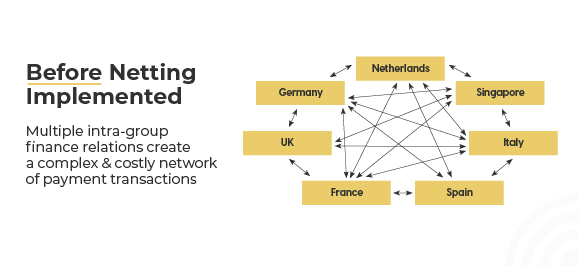
Traditional IC transaction setup

A strategy to improve this traditional way of working is to implement a netting centre, or better yet, in-house bank, that can streamline processes. The benefits of such a setup are standardized processes controlled centrally, improved timeliness of payments, fewer transactions equals lower transaction costs, FX managed centrally and traded at larger volumes allowing more favorable rates, high central visibility into all intercompany transactions, and often you will need fewer banks to which can reduce float. In theory such a setup looks like the following:
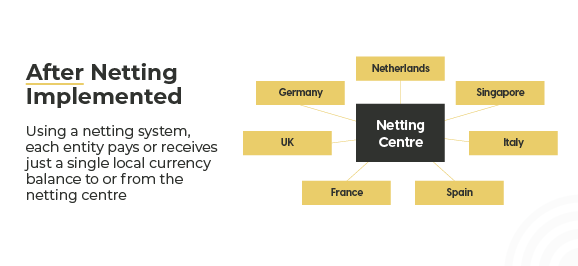
Modern IC transaction setup

Navigating intercompany transactions: optimizing efficiency and compliance

In conclusion, navigating the complexities of intercompany transactions requires a thorough understanding of their meaning, types, and related processes and documentation. By implementing the right strategies and leveraging technology, multinational corporations can streamline their operations. The crucial connection between intercompany accounting and transactions highlights the importance of accurate recording, reconciliation, and elimination in consolidated financial statements. Through case studies like intercompany netting, organizations can witness firsthand the impact of optimized frameworks in improving efficiency, reducing costs, and enhancing visibility across their corporate groups. As businesses continue to evolve in a global landscape, effectively managing intercompany transactions remains crucial for sustainable growth and success.

Also Read

Check our other blogs

This article is written by our partner, FIS

Key takeaways

  • Recent events illustrate that receivables finance remains vulnerable to fraud risks, such as invoice fabrication and double pledging, particularly when relying on manual processes and weak governance.
  • Advanced technology mitigates risk through real-time data integration, automated anomaly detection and shadow ledgers, reducing reliance on manual reporting and creating a single source of truth.
  • The most resilient frameworks combine digital efficiency with human oversight, ensuring automated alerts are reviewed by experienced professionals who understand the nuances of complex transactions.

Receivables finance (RF) has long been a cornerstone of corporate finance, enabling businesses to convert outstanding invoices into immediate liquidity. By selling their receivables to a funder, companies may access cost-effective funding and reduce risk, while investors may gain exposure to short-duration, diversified assets at a competitive return.

However, as recent events surrounding First Brands Group illustrate, this structure remains vulnerable to risks beyond credit, such as fraud. These vulnerabilities highlight the need for greater scrutiny and the adoption of new technologies.

How does fraud occur in RF transactions?

Fraud in RF transactions typically manifests through misrepresentation of receivables quality, double pledging of assets and fabrication of invoices. These risks arise because RF relies heavily on the integrity of the originator’s reporting and servicing processes. If invoices are falsified or pledged to multiple financiers, the asset base becomes compromised, exposing investors and lenders to significant losses.

The First Brands case underscores these vulnerabilities. The U.S. auto parts supplier, which filed for Chapter 11 reorganization in September 2025, allegedly engaged in widespread financial misconduct, including doctoring invoices and double-counting receivables to secure billions of dollars in financing.

What makes RF vulnerable to fraud?

Several market features of RF contribute to fraud risk:

  1. Information asymmetry: Investors and lenders may rely on originator-provided data without analyzing historical data and internal credit and operational processes.
  2. Servicer dependence: Given the usually heavy operational workload, originators may continue servicing receivables post-sale, creating opportunities for manipulation if internal controls are weak.
  3. Origination through fintech platforms: Many funders want access to this space, interested in the return relative to the short-term nature of the asset. However, by delegating the responsibility of originating and structuring, they may not receive detailed transaction information – exposing them to risk, given that such platforms do not normally have skin in the game.

These factors can make RF particularly vulnerable when governance fails or liquidity pressures incentivize aggressive accounting.

How can technology help detect fraud in RF?

The First Brands saga has accelerated calls for digital transformation in RF oversight. Advanced technology and reporting platforms can reduce fraud risk through:

  1. Real-time data integration and monitoring: Cloud-based platforms enable continuous monitoring of receivables performance across geographies. By aggregating item-level data from ERP systems and payment gateways, these solutions can provide a single source of truth, reducing reliance on manual reporting.
  2. Elimination of manual processes: When files are provided manually, there is no barrier to manipulating the asset file while moving from ERP to funder. With an automated solution, a fraudulent actor would have to manipulate the ERP on a recurrent basis, as opposed to changing a simple spreadsheet.
  3. Creation of a shadow ledger: An automated reporting tool can monitor each invoice in a relevant pool of assets. If properly implemented, a funder can track asset performance across the entire range of seller entities and ERPs. This helps to detect unusual performance patterns such as reappearing invoices, duplicates, or amount and due date changes.
  4. Automated checks and anomaly detection: Certain advanced digital tools now enable continuous scrutiny of receivables portfolios, automatically flagging inconsistencies such as atypical aging profiles and deviations from established dilution trends. By utilizing such technology, funders and investors can be better equipped to identify and address potential risks before they escalate.
  5. Transparent and detailed reporting frameworks: Industry initiatives promoting simple, transparent and standardized structures, coupled with automated waterfall calculations and trigger monitoring, may enhance investor confidence and regulatory compliance. This can be absent when investing through fintech platforms where information provided by the corporate is shared in an aggregated format with limited scrutiny.

What will shape the future of RF?

The collapse of First Brands is a cautionary tale for all stakeholders in the RF ecosystem. While RF remains a powerful liquidity tool, its resilience depends on effective governance and technological safeguards. Platforms that deliver real-time transparency, automated controls and immutable records are no longer optional: They are essential to maintaining trust and confidence in this asset.

In essence, resilient frameworks are often built on digital efficiency and the irreplaceable insight of experienced practitioners.

As institutional investors continue to seek exposure to trade finance assets and corporates aim to unlock working capital, the combination of advanced technology and human expertise within complex RF structures will help to shape the market’s future.

While digitalization may stand as the frontline defense against fraud, it’s equally vital to maintain effective human oversight by having seasoned professionals conduct independent reviews and engage in regular dialog with originators and funders.

This interplay between technological innovation and expert judgment helps ensure that not only are anomalies flagged automatically, but also the nuances of complex transactions are properly understood and addressed. In essence, resilient frameworks are often built on digital efficiency and the irreplaceable insight of experienced practitioners.

Join our Treasury Community

Treasury Masterminds is a community of professionals working in treasury management or those interested in learning more about various topics related to treasury management, including cash management, foreign exchange management, and payments. To register and connect with Treasury professionals, click the button below.

This article is written by Nomentia

Why are manual treasury processes expensive?

Manual treasury processes become expensive because they require recurring effort to collect balances, prepare payment files, update forecasts, check approvals, and reconcile data. Even when each task seems manageable, the combined impact can reduce efficiency, slow down decision-making, and increase operational risk.

Treasury teams are used to making imperfect systems work.

A spreadsheet here. A bank portal there. A local ERP export from one entity, a payment file from another, and a cash forecast that still depends on email updates from the business. None of these workarounds may look dramatic on their own. In many organisations, they are even seen as normal.

The problem is that “normal” can become expensive.

Manual treasury operations rarely create one large, visible cost line. Instead, they create a pattern of hidden costs: time spent collecting data, delays in decision-making, duplicated effort, payment exceptions, outdated forecasts, missed visibility, and control gaps that only become urgent when something goes wrong.

That is why treasury automation ROI should not only be discussed as a technology question. It is also an operating model question. How much time does treasury spend managing the process instead of managing cash, liquidity, payments, and risk?

Why manual treasury work is difficult to measure

The cost of manual work is often underestimated because it is distributed across people, entities, systems, and routines.

A treasury analyst may spend hours preparing a daily cash position. A regional finance team may manually upload payment files. Another person may validate bank data, check approvals, update forecasts, or investigate why one bank statement does not match the expected format.

Each task may be manageable. Combined, they create a significant operational burden.

This is also why many teams struggle to build a cash forecasting business case. The value of better forecasting is not limited to “faster reporting”. It is the value of better decisions: knowing earlier where liquidity is needed, reducing dependency on outdated data, improving confidence in funding decisions, and giving leadership a clearer view of what may happen next.

External research points in the same direction. PwC’s 2025 Global Treasury Survey notes that treasury teams are under pressure to improve cash visibility, cost efficiency, and risk management, while leading organisations increasingly adopt real-time liquidity tools, AI-enhanced forecasting, and centralised payment models. HSBC also highlights that cash flow forecasting has remained a key treasury priority, reflecting the need for precise and timely forecasts in a volatile environment.

In other words, manual treasury processes are not only inefficient. They can slow down the organisation’s ability to respond.

The cost of fragmented cash visibility

Cash visibility is one of the clearest examples of hidden treasury cost.

When balances are collected manually across banks, accounts, currencies, and entities, treasury may technically have the data, but not necessarily in time to act on it. The team may know yesterday’s position, but not today’s. It may have a consolidated view, but only after several people have updated files, checked bank portals, and reconciled different formats.

That delay matters.

Without timely visibility, companies may keep too much cash idle in one place while borrowing elsewhere. They may struggle to identify trapped cash. They may make liquidity decisions based on incomplete information. They may also spend valuable time explaining numbers instead of improving them.

Nomentia positions its Smart Treasury Suite around visibility, control, and predictability across payments, cash, liquidity, and risk, integrating with ERPs, banks, and other systems. For companies operating across multiple banks and entities, that integration layer is not just technical infrastructure. It is the foundation for turning fragmented data into usable treasury insight.

The cost of manual payments

Payments are another area where manual processes can appear cheaper than they really are.

At first glance, uploading files through bank portals or managing payments across local workflows may seem acceptable. The team knows the process. The banks are connected somehow. Payments are executed. Work continues.

But payment operations carry a high cost when they depend on scattered portals, inconsistent approvals, manual file handling, and local exceptions.

The hidden costs include time spent preparing and checking payment files, resolving format issues, validating approvals, tracking payment statuses, and answering questions from subsidiaries, AP teams, banks, and auditors. More importantly, weak payment control can increase exposure to duplicate payments, missed cut-offs, fraud attempts, and compliance issues.

This is where payment automation benefits become easier to explain. Automation is not only about faster payment execution. It is about standardising the process, improving traceability, reducing manual intervention, and making payment control easier to prove.

The cost of unreliable forecasting

Forecasting is often where manual treasury processes become most visible to leadership.

The CFO does not necessarily see how many files were collected, how many emails were sent, or how many adjustments treasury made before the forecast was ready. But the CFO does see when the forecast is late, when confidence is low, or when the numbers change without a clear explanation.

A manual cash forecast can still be useful. Many experienced treasury teams are excellent at working around incomplete data. But as the business grows, expands into new markets, adds banks, or inherits systems through acquisitions, the limits become harder to ignore.

Forecasting depends on data quality, timing, ownership, and repeatability. If treasury spends too much time gathering inputs, it has less time to analyse drivers, challenge assumptions, and model scenarios. A forecast that takes days to prepare may already be outdated when it reaches decision-makers.

This is why the business case for treasury automation should include both time savings and decision quality. Faster data collection is valuable. But the larger value often comes from giving treasury more time to interpret what the numbers mean.

The cost of controls that rely on people remembering the process

Manual controls are often built around expertise. The team knows which approvals are needed, which files need checking, which bank deadlines matter, and which exceptions require escalation.

That works until complexity increases.

As more entities, banks, users, and payment types are added, control becomes harder to manage consistently. Processes may differ across countries. Approval rules sit outside the system. Audit trails may require manual reconstruction. Exceptions depend on individual knowledge rather than embedded workflows.

In a stable environment, this may go unnoticed. During growth, restructuring, audit, staff changes, or periods of financial pressure, it becomes a risk.

The Nomentia Treasury Trends Report 2026 describes treasury teams facing pressure to deliver real-time insights, stronger controls, and more strategic input, often while dealing with fragmented systems and limited IT support. The report is based on 384 treasury and finance leaders across the Nordics, DACH, Benelux, and the UK.

That is the reality many treasury teams recognise: expectations are rising faster than operational capacity.

How to think about treasury automation ROI

A strong treasury automation ROI discussion should not begin with software features. It should begin with operational impact.

  • Where is treasury losing time today?
  • Which manual tasks are repeated every day, week, or month?
  • Where do payment processes create avoidable risk?
  • How much effort goes into collecting and validating data?
  • Which decisions are delayed because cash visibility or forecasts are not ready?

From there, TMS cost savings become easier to frame. The value may come from fewer manual hours, lower operational risk, more efficient payment execution, improved cash visibility, reduced dependency on spreadsheets, or stronger audit readiness.

The most useful business case is not a generic promise that automation saves money. It is a structured estimate of where the organisation currently loses time and where better treasury processes could create measurable improvement.

Also Read

Join our Treasury Community

Treasury Masterminds is a community of professionals working in treasury management or those interested in learning more about various topics related to treasury management, including cash management, foreign exchange management, and payments. To register and connect with Treasury professionals, click the button below.
This article is written by Cobase

For an industry built on numbers, banking has always struggled with something more basic: speaking the same language.

Ask any treasury team trying to connect to banks globally and you’ll hear a familiar frustration. The expectation is simple – money is digital, banks are global, so connectivity should be straightforward. In reality, it rarely is. What looks like a plumbing issue is something deeper: a system that was never designed to be unified in the first place.

Modern banking didn’t emerge as a coordinated network. It grew in fragments. National systems were built to serve domestic economies, shaped by local regulation, infrastructure, and political priorities. Payment schemes evolved independently. Messaging formats were defined in isolation. Even basic concepts like how to confirm a payment or report a balance took different forms depending on where you looked.

The result is not just variation, but incompatibility.

SWIFT is often held up as the closest thing to a global standard. And in one sense, it is. It created a common messaging layer that banks across the world could use. But it never standardised what happens after the message is sent. Two banks can receive the same SWIFT instruction and process it in entirely different ways – different cut-off times, different validations, different interpretations.

This is where the idea of “bank connectivity” begins to unravel. The challenge is not just reaching a bank, but dealing with how each bank behaves once you do.

Over the years, the industry has made repeated attempts to smooth this out. None have fully succeeded. Not because the technology wasn’t good enough, but because the incentives never aligned. Banks compete. Regulators don’t coordinate globally. And legacy systems – often decades old – continue to run critical infrastructure that no one is willing to replace lightly.

The expectation of a unified system persists. But it’s built on a false premise.

Banking isn’t fragmented because something went wrong. It’s fragmented because that’s how it was built.

The API promise, and its limits

Few ideas in banking have generated as much optimism in recent years as APIs.

They arrived with the promise of simplicity. Clean, modern interfaces. Real-time data. Standardised access. Compared to the heavy, file-based integrations of the past, APIs looked like a reset moment, a chance to finally make bank connectivity behave like the rest of the digital world.

And in some ways, they delivered.

Large banks began exposing endpoints for payments and reporting. Developers could interact with bank systems without navigating layers of legacy protocols. In controlled environments, things worked exactly as advertised.

But step outside those environments, and the picture changes.

APIs in banking are not a single standard. They are dozens, sometimes hundreds, of individual implementations. Each bank defines its own structure, its own authentication methods, its own limits. Even when two banks claim to follow the same framework, the differences show up quickly – in edge cases, in error handling, in performance under load.

The regulatory push behind open banking added momentum, but also confusion. PSD2 created a baseline, but it was never designed for corporate treasury. It focused on retail use cases, with limited scope for bulk payments, complex approval flows, or multi-entity structures. For large organisations, it solved a small part of a much bigger problem.

Meanwhile, neo-banks and aggregators entered the picture, offering simplified access and faster onboarding. They improved the experience at the edges, particularly for account opening and basic transactions. But they didn’t remove the need to engage with traditional banks. In many cases, they simply added another layer to manage.

The result is a familiar pattern in financial infrastructure. New technology doesn’t replace the old – it accumulates around it.

APIs didn’t eliminate fragmentation. They made it more dynamic.

Inside the hidden work of making banks “just work”

From the outside, bank connectivity looks deceptively simple. Payments go out, balances come in, and everything appears to move through a single system.

What’s less visible is the machinery underneath.

For companies operating across multiple countries, connectivity is not one connection, it’s dozens. Each bank brings its own requirements. File formats differ. Security models vary. Some require certificates, others tokens. One bank processes payments in batches, another in real time. Cut-off times shift by region, sometimes by product.

Even within the same bank, behaviour can change depending on the channel used. An API might support one set of payment types, while host-to-host supports another. Documentation doesn’t always reflect reality. Test environments behave differently from production. Exceptions are handled inconsistently.

None of this is unusual. It’s the normal state of the system.

This is why, despite all the talk of innovation, older methods remain firmly in place. Host-to-host connectivity – direct, file-based integration – continues to handle a large share of corporate payments. It’s not elegant, but it’s predictable. It does what it’s supposed to do, at scale, without surprises.

In certain markets, local standards dominate. EBICS, for example, is deeply embedded in parts of Europe. It works not because it’s globally relevant, but because it reflects the specific needs of those markets. In those contexts, it often outperforms more “modern” approaches simply by being consistent.

And then there’s SWIFT, still acting as the global fallback. When no direct connection is available, SWIFT is usually there. Not perfect, not always efficient, but broadly accepted.

Put all of this together, and a pattern emerges. There is no single best way to connect to banks. There is only a set of trade-offs.

The real work is not choosing one method, but managing all of them at once, and making them behave as if they were one.

That work increasingly sits in a layer most corporates never set out to build, but inevitably do: an orchestration layer that absorbs differences between banks, channels, and formats, and presents something coherent on top.

This is where platforms like Cobase operate.

Rather than trying to standardise banks themselves, Cobase standardises the interaction with them. It connects across SWIFT, EBICS, APIs, and host-to-host channels, translating between formats, normalising data, and embedding bank-specific behaviour into a central system. A payment instruction created once can be converted automatically into whatever each bank requires. Data coming back – balances, statuses, confirmations – is aligned into a consistent structure.

The complexity doesn’t disappear. It is relocated.

Instead of sitting in day-to-day treasury operations spread across teams, spreadsheets, and manual fixes, it is contained within a controlled layer designed to handle it.

Because in the end, the hardest part of bank connectivity is not building connections.

It’s making them invisible.

Also Read


Join our Treasury Community

Treasury Masterminds is a community of professionals working in treasury management or those interested in learning more about various topics related to treasury management, including cash management, foreign exchange management, and payments. To register and connect with Treasury professionals, click the button below.