This article is written by Nomentia
Intercompany (IC) transactions (or intra-group transactions) are heavily used in the operations of multinational corporations, where financial exchanges between entities within the same corporate group occur frequently. While these transactions offer operational flexibility and efficiency, they also present unique challenges in terms of efficient accounting processes, compliance, and financial reporting. In this blog post, we’ll dig into the intricacies of intercompany transactions and explore strategies for effectively managing them. There will also be a bonus case study on what optimized intra-group payment setups can look like. But first, let’s have a closer look at what IC transactions actually mean and how they work.

Despite there being various types of intercompany/intra-group transactions, they can generally be defined as transactions that occur between different entities within the same parent company or corporate group. These transactions can involve the transfer of goods, services, or financial assets between subsidiaries, divisions, or other affiliated entities within the organization.
Intercompany transactions can be categorized into three main types based on the direction of the transaction and the relationship between the entities involved:
The categorizations help to understand the directional flow of transactions and the dynamics within the corporate group. Each type of transaction serves specific business objectives and requires careful consideration of factors such as pricing, documentation, and compliance with local regulatory requirements.
When it comes to the actual transactions themselves, various examples are relevant for finance, accounting, and treasury teams. They illustrate how diverse the nature of intercompany transactions is and how crucial they are for multinationals to function properly. The most common examples of intercompany transactions include:
Each intra-group transaction requires a slightly different approach, varying stakeholders, documentation, or compliance. It can be very challenging for companies to manage them efficiently and transparently.
To provide more clarity about the actual work that goes into each example of IC transaction, you can look at the related processes that consist of several steps involving various stakeholders within the organization along the way. How these tasks are divided highly varies in each organization. Yet, you can usually see that the process looks similar to the one below:
Companies need to identify transactions that occur between different entities within the same corporate group. These transactions may include sales of goods, provision of services, loans, transfers of assets, royalties, or other types of financial exchanges.
Once identified, intercompany transactions are recorded in the accounting records of the participating entities. Each transaction is recorded at fair market value, which is the price that would be agreed upon by unrelated parties in an arm’s length transaction.
The transactions need to be eliminated from the consolidated financial statements to avoid double-counting. When the parent company prepares its consolidated financial statements, it combines the financial results of all its subsidiaries into a single set of financial statements. To ensure accuracy, intercompany revenues, expenses, assets, and liabilities are eliminated during the consolidation process.
One of the critical aspects of intercompany transactions is determining the transfer price, which is the price at which goods or services are transferred between related entities. Transfer pricing is crucial for tax purposes and to ensure that each entity within the corporate group is fairly compensated for its contributions.
Companies must maintain proper documentation of intercompany transactions to comply with accounting standards, tax regulations, and transfer pricing rules. This documentation typically includes intercompany agreements, invoices, pricing policies, and other relevant records.
IC transactions can have significant tax implications, especially when they involve entities in different tax jurisdictions. Tax authorities scrutinize the transactions to ensure they are conducted at arm’s length and that transfer prices are set in accordance with regulations to prevent tax evasion and profit shifting.
7. Risk management
Managing risks associated with intercompany transactions is crucial. Companies need to ensure compliance with regulations, mitigate transfer pricing risks, and maintain transparency in their financial reporting to avoid legal and financial repercussions.
It is clear that IC transactions play a vital role in the operations of multinational corporations, facilitating the efficient allocation of resources, sharing of expertise, and coordination among different entities within the corporate group. Simultaneously, it’s a time-consuming process that requires many steps, stakeholder management, and documentation. Let’s zoom in on the documentation aspect further, since that’s where companies can optimize processes in particular.
Traditionally, intercompany transactions are documented through various means to ensure proper record-keeping, compliance, and transparency within the corporate group. Some common documentation methods include:
Intercompany agreements: formal agreements that are drafted to outline the terms and conditions of intercompany transactions. These agreements specify the nature of the transaction, pricing mechanisms, payment terms, and any other relevant provisions.
Invoices and billing statements: invoices are issued for goods sold, services rendered, or other transactions conducted between entities within the corporate group. These invoices detail the quantity, description, price, and total amount due for the transaction.
Transfer pricing documentation: transfer pricing documentation is prepared to support the pricing of intercompany transactions in accordance with applicable tax regulations. This documentation typically includes a transfer pricing study, analysis of comparable transactions, and documentation of the pricing methodology used.
Accounting records: each intercompany transaction is recorded in the accounting records of the participating entities. These records include journal entries, ledgers, and other financial documents that capture the details of the transaction for internal and external reporting purposes.
Intercompany reconciliation: there need to be regular reconciliation processes in place to ensure that intercompany balances and transactions are accurately recorded and reconciled between the entities involved. This helps identify and resolve any discrepancies or errors in the accounting records.
Even if this documentation process sounds labor-intensive, there are ways to make it more efficient, for example, by adopting dedicated tools. Other improvements and strategies we’ll discuss more in detail below.
Optimizing the documentation and other laborsome tasks related to intercompany transactions involves implementing efficient processes and leveraging the right technologies. Some of the most common strategies to optimize intercompany documentation include:
Establish standardized templates, formats, and procedures for documenting intercompany transactions to ensure consistency and efficiency across the organization.
Utilize accounting software and enterprise resource planning (ERP) systems to automate the generation of invoices, recording of transactions, and reconciliation processes. To take it a step further, you can connect these systems to a treasury management system to fully integrate the processes with all entities’ banks. Automation through technology typically reduces manual errors, saves a lot of time, and improves data accuracy and transparency.
Maintain a centralized repository or digital database to store all intercompany agreements, invoices, and documentation. This ensures easy access to relevant information and facilitates better compliance monitoring and auditing access. This can also be done with dedicated technology.
Implement electronic signature solutions to expedite the approval and execution of intercompany agreements and other documents. Electronic signatures streamline the workflow and reduce administrative delays associated with manual signatures. You can often fully integrate them with different processes and tools you already use.
Real-time reporting provides stakeholders with punctual insights into intercompany transactions and financial performance. It can help enable proactive decision-making and enhance organizational transparency for all relevant stakeholders.
Combining these strategies will allow your team to work more efficiently and open up the possibility to focus on other essential tasks that are otherwise neglected due to resource constraints.
Let’s elaborate more on the technologies that you can actually use to improve IC transaction operations. Like with most processes, the answer to making intercompany transactions more efficient is technology. Several technologies can help streamline and optimize intercompany transactions. This is a list with the main technologies you can leverage:
All in all, various technologies exist that can really help ease the management of IC transactions. Some tools require more expertise or know-how than others. As a result, most companies opt for software-as-a-service that provides the convenience of the technology being fully implemented, updated, and created by a specialized vendor.
In the context of IC transactions, IC accounting is often mentioned and also plays a big role. Intercompany accounting encompasses the recording, reconciliation, and elimination of these transactions in the financial records of the participating entities. The connection between intercompany accounting and intercompany transactions lies in how intercompany transactions necessitate accurate accounting practices to ensure transparency, compliance, and reliability in financial reporting. Intercompany accounting ensures that intercompany transactions are properly recorded, reconciled, and eliminated in the consolidated financial statements of the parent company. Ultimately, intercompany accounting plays a vital role in providing a comprehensive view of the financial performance and position of the entire corporate group.
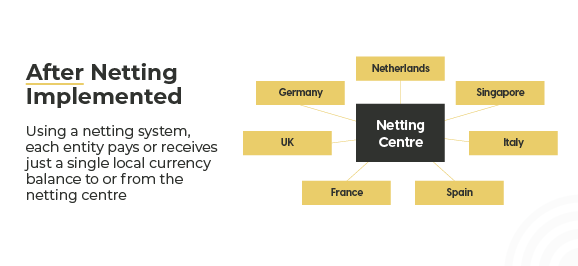
One good example of intercompany process optimization is for example company netting. A netting solution can help organize payments and receivables between entities in a structured and cost-efficient manner based on a centralized netting centre. We wrote an entire article dedicated to it that you can find here: what is intercompany netting and how does it work?
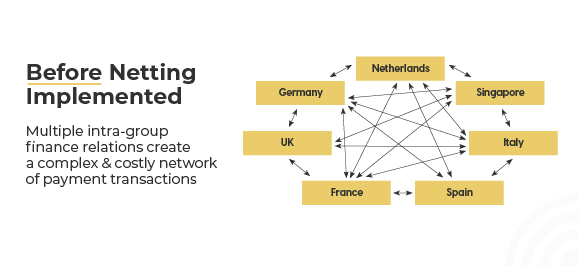
In short, a traditional intra-group transaction model looks very challenging to manage, with high transfer costs, many costly FX deals, unresolved disputes between subsidiaries, lots of communication, and difficulties with achieving cash visibility. To illustrate, the setup looks like the one below:
A strategy to improve this traditional way of working is to implement a netting centre, or better yet, in-house bank, that can streamline processes. The benefits of such a setup are standardized processes controlled centrally, improved timeliness of payments, fewer transactions equals lower transaction costs, FX managed centrally and traded at larger volumes allowing more favorable rates, high central visibility into all intercompany transactions, and often you will need fewer banks to which can reduce float. In theory such a setup looks like the following:
In conclusion, navigating the complexities of intercompany transactions requires a thorough understanding of their meaning, types, and related processes and documentation. By implementing the right strategies and leveraging technology, multinational corporations can streamline their operations. The crucial connection between intercompany accounting and transactions highlights the importance of accurate recording, reconciliation, and elimination in consolidated financial statements. Through case studies like intercompany netting, organizations can witness firsthand the impact of optimized frameworks in improving efficiency, reducing costs, and enhancing visibility across their corporate groups. As businesses continue to evolve in a global landscape, effectively managing intercompany transactions remains crucial for sustainable growth and success.

By Alexander von Schirmeister,
CEO at Nomentia
A bank portal still works. The ERP still produces data. A spreadsheet still calculates a forecast. A payment approval workflow still moves from one person to the next. Reports still reach the CFO, even if they arrive later than expected. From the outside, treasury appears to function. Inside the process, finance teams know exactly how much effort is required to keep that appearance of control intact.
Modern treasury cannot rely on disconnected systems because the questions it needs to answer are no longer isolated. Cash visibility depends on bank data, account structures, ERP information, payments in progress, forecast inputs, intercompany flows, financing activities, and exposures. Liquidity planning depends on operational data from the business, but also on treasury assumptions, market conditions, working capital movements, and funding plans. Risk management depends on reliable exposure data, but also on trade execution, hedge documentation, limits, reporting, and accounting. If each part of this picture sits in a different place, the treasury team becomes the integration layer.
That integration work rarely surfaces. It lives in copy-and-paste routines, manual file checks, email reminders, reconciliation notes, spreadsheet tabs, and individual memory. It is also where most treasury management challenges quietly begin.
Disconnected systems create time loss because data has to be gathered before it can be analysed. They create duplicated work because teams maintain local trackers even when central tools exist. They weaken cash visibility because the latest view may depend on which bank file has arrived or which entity has responded. They weaken controls because exceptions are harder to identify when workflows are not connected.
The CFO does not usually see the process friction. The CFO sees the answer. If the answer is late, inconsistent, or hard to explain, confidence falls. Senior leadership needs reliable responses to simple but high-stakes questions: How much liquidity is available? Which cash flows are expected? Where is working capital tied up? Are internal payments efficient? Which exposures are material? Are guarantees, hedges, and commitments under control? These questions cannot be answered well when the data behind them has to be rebuilt every time.
The 2026 Nomentia Treasury and Cash Management report highlights that many treasury teams are in a transitional phase. They have moved beyond purely manual treasury, but still rely on multiple systems and partial automation. The pattern is familiar: the organisation has invested in technology, yet treasury still spends too much time reconciling information and validating reports. The issue is not that systems are missing. The issue is that they are not connected enough to support the pace of decision-making.
Disconnected systems are especially risky in three areas.
The first is visibility. If cash positions, transactions, forecasts, and payment statuses are not consolidated, treasury may see parts of the picture but miss the direction of movement. A balance report can show where cash is today, but it does not explain whether the position is temporary, restricted, exposed, or needed elsewhere in the group. Visibility without context can create false comfort.
The second is control. Treasury policies often look clear on paper, but control depends on how processes actually run. Who can approve a payment? Which entities have followed the forecast process? Which exposures have been validated? Which guarantee is close to expiry? Which hedge relationship needs attention? When workflows are disconnected, control becomes dependent on manual follow-up. That may work when volumes are low, but it becomes unreliable as banks, entities, instruments, and reporting expectations increase.
The third is decision speed. In volatile markets, delayed answers are not neutral. A late forecast can affect funding decisions. A delayed exposure view can affect hedge timing. A slow payment status check can affect supplier confidence. A late view of guarantees or credit line usage can affect working capital decisions. Treasury does not need real-time data for every decision, but it does need enough connected information to avoid making decisions with yesterday’s understanding.
A modern treasury management system should not be judged only by feature breadth. The more important question is how well it reduces the gaps between systems, data, workflow, and reporting. A strong setup connects bank information, ERP data, payment processes, cash forecasting, risk workflows, analytics, and audit trails into a reliable operating model. That does not mean every company needs every module at once. It means the architecture should support growth without forcing the team to rebuild its processes every time complexity increases.
Most people researching a TMS today will start with a web search or ask Copilot, Gemini, or ChatGPT. The answer they get back is usually a feature list. That’s not wrong, but it’s incomplete. A good treasury management system helps finance teams centralise cash, payments, forecasting, risk, controls, and reporting so they can make better liquidity and financial risk decisions with trusted data. Features are how it gets there. That’s the distinction worth keeping in mind when evaluating whether your current setup is still fit for purpose.
The path away from disconnected systems does not always require a large replacement project. In many organisations, the better approach is to identify the most painful manual bridges first. Where does treasury re-enter data? Where does the team wait for local input? Where do reports need manual explanation? Where are approvals outside the system? Where is the same number calculated in different ways? These questions show where fragmentation is creating the most business risk.
Connected systems create reliable answers. They reduce the manual work behind cash visibility, improve the quality of cash flow forecasting, and support stronger controls and compliance. They help the CFO understand not only what the numbers are, but what they mean for liquidity, risk, and action. Disconnected systems may still function. But they make treasury work harder than it should, and confident decisions harder than they need to be.
Treasury Masterminds is a community of professionals working in treasury management or those interested in learning more about various topics related to treasury management, including cash management, foreign exchange management, and payments. To register and connect with Treasury professionals, click the button below.