A deep dive: Simplifying guarantee management for treasury & finance

This article is written by Nomentia

Treasurers have a love-hate relationship with guarantees. While they are usually not a big concern as long as there are few, managing hundreds or even thousands of various types of guarantees across different entities, guarantors, beneficiaries, countries, and therefore languages and jurisdictions can be a nightmare, especially without the right tools. Below, we provide insights into what managing guarantees actually means, what the challenges are when doing so and why doing it right equals less time spent and money saved. In the second part of this post, we provide an overview of the capabilities that modern, digital guarantee management solutions offer and their benefits.

JOIN OUR FORUM TODATY!

Are you an experienced treasurer or someone looking to enhance their knowledge of financial management? We extend a warm welcome to testbanana.nl/treasurymastermind/

Join our vibrant community and become a valued member of a network that prioritizes collaboration, expertise, and the pursuit of excellence in corporate treasury.

Let’s initiate discussions and together elevate the art and science of treasury management!

Why guarantees matter

Guarantees facilitate trade by assuring the buyers/project owners (“beneficiaries”) that the guarantor, usually a bank or (credit) insurance company – will uphold a contract in case the seller/contractor (“the applicant” to the guarantee) is unable to do so. They are therefore a vital tool heavily used across sectors as varied as construction, facility management, manufacturing, and retail and across the different stages of a business transaction, from bidding for a project, the delivery of the goods or performance of the services to ensuring pre-agreed services during the warranty period. By committing to paying the agreed amount upon first demand by the buyer, the guarantor (usually a bank or credit insurer) assumes risk. Compensation for this risk is in the form of various guarantee-related fees. Also, guarantors usually only agree to assume a pre-defined amount of risk for any given company in the form of a pre-agreed guarantee facility. Against this background, it is obvious that managing large portfolios can be a challenge. Not only is the timely processing of guarantees from various facilities agreed upon with various banks, but sometimes hundreds, if not thousands, of different types of guarantees can be challenging.

What is guarantee management?

Guarantee management means the management of all guarantees for a company. A guarantee itself is a way of showing a counterparty that you are a secure contracting party. The guarantee is set up with a third party, most often a bank. The bank acts as a mediator and becomes the guarantor as the guarantee transfers the applicant’s creditworthiness to the bank.

ALSO READ

Why do companies need to manage their guarantees?

Companies that engage in substantial contractual agreements that can impact financial risk need to manage all the related guarantees, provided that a guarantee is issued. As a result, finance and treasury teams typically practice some form of guarantee management, for example, by keeping track of guarantees and status in spreadsheets to gain better control. It’s important to keep track of guarantees in order to move forward with agreements in a timely fashion and to control the costs and risks of agreements.

Another important aspect of trade finance is risk mitigation and settling any conflicts between trading partners. For example, the buyer usually wants to mitigate the payment risk and ensure security if, for some reason, the seller does not provide the agreed-upon goods or services. In contrast, the seller wants to mitigate supply chain risk. By using guarantees, companies minimize the risk in such situations and can move forward with agreements in a more secure manner.

Challenges in traditional guarantee management processes

Guarantee management traditionally implies a good amount of paperwork and manual spreadsheets where information about each guarantee is recorded and updated. The management is, in most cases, also decentralized, where every entity or subsidiary has its own ways of dealing with guarantees. As a result, there is much scattered data in various places, and processing guarantees become slow due to inefficiency and lots of required communication. Especially since several stakeholders are involved throughout a guarantee’s lifecycle, both internally and externally.

In practice, that implies that many emails need to be sent back and forth between people, and if various entities need to align on guarantees or a corporation decides to issue guarantees for its subsidiaries, there is no standardized process in place that streamlines the communication, guarantee status, or tasks for all stakeholders. Traditional setups are a nightmare for companies that process tens, hundreds, or thousands of guarantees.

Common goals in guarantee management

Most companies that are looking to improve their guarantee management processes share the following common goals:

  1. Transparency at the corporate level: group-wide overviews that allow you to quickly see the bigger picture of all existing guarantees at any time.
  2. Transparency for subsidiaries: allowing subsidiaries to keep track of and view all, guarantees that were issued on their behalf.
  3. Control of guarantee exposure: the utilization of current facilities is clearly presented, allowing quick calculations and clarification on the available resources for planned guarantee requirements.
  4. Invoicing of internal guarantee charges: invoicing functionalities for dealing with fees and commissions related to guarantees.
  5. Time-savings: automating and digitalizing the end-to-end guarantee process from application to bank approval to storing all guarantee-related records in a single platform with the help of customizable workflows. All in all, improving efficiency over the course of the entire guarantee lifecycle.

Desired guarantee management setups

The aforementioned goals are paired with a desired state of guarantee management that is centralized in a digitalized environment. All employees responsible for guarantee management or those with a role in the guarantee lifecycle should be able to log on to that same system, regardless of whether they work for a corporate or a subsidiary. It’s just a matter of user management and ensuring that users have adequate permissions to view and edit the guarantees relevant to their jobs. Communication between colleagues and adjustments to guarantees should only be done in the same system. It should also be able to provide overviews of all guarantees and their statuses, as well as which guarantees require action to move them forward in the process.

On top of that, a guarantee management setup should be designed to be standardized for every bank. Typically, banks issue their own guarantee forms that all require information to be filled out slightly differently depending on which bank you are dealing with. This adds another layer of complexity and additional work to the process. Instead, digitalized tools can be used for creating standardized guarantee forms that can be sent to any bank, regardless of their requirements. By doing so, treasurers can save significant time because all guarantee applications follow the same standard digital format.

A modern, digital guarantee management process

An example of the desired state of the guarantee management process looks similar to the illustration below. In brief:
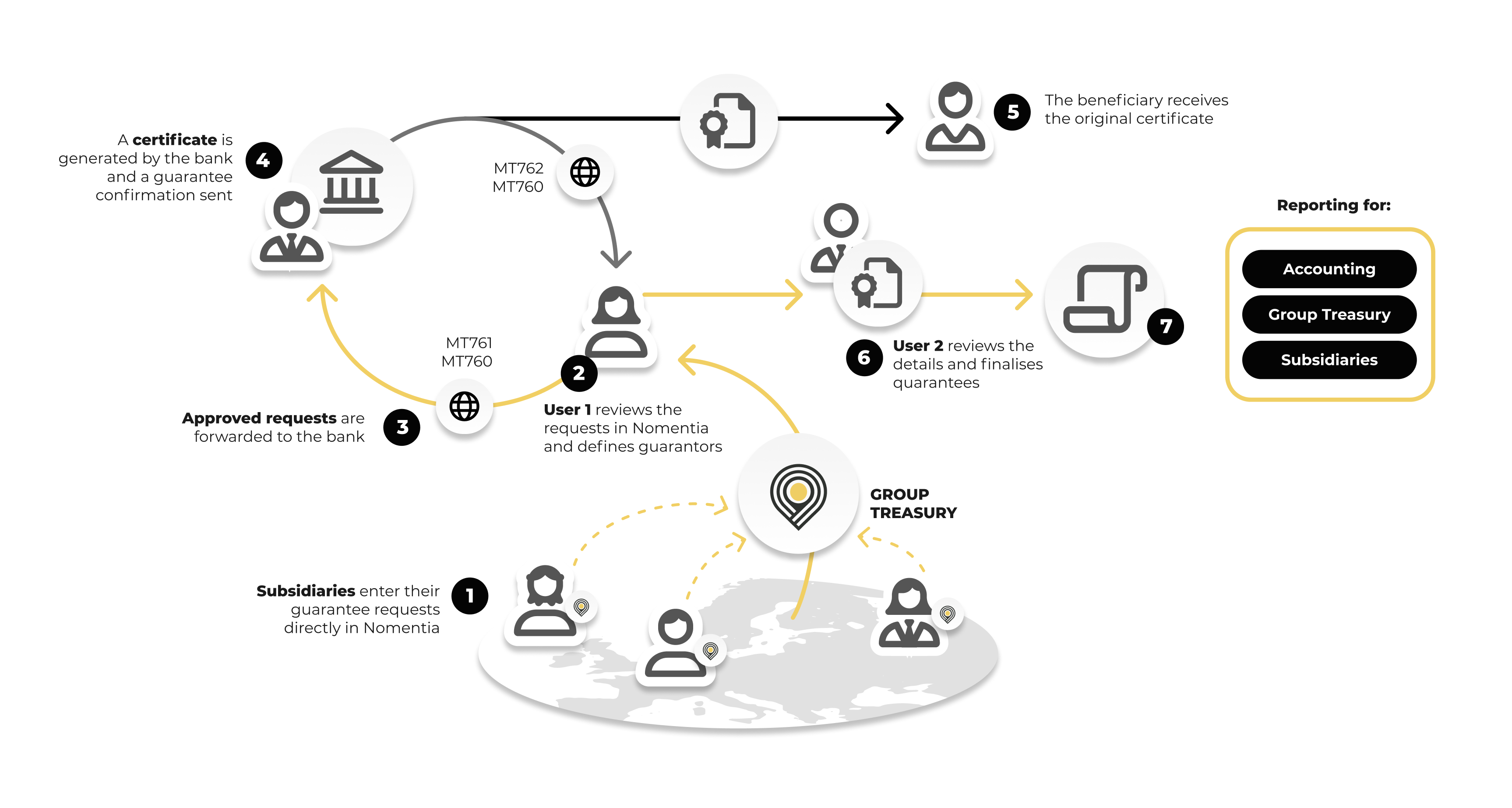
  1. Someone in the subsidiary enters a request for a guarantee in the centralized system.
  2. Another user (often in group treasury) receives a notification, reviews the guarantee, and defines the guarantors.
  3. Requests can be approved, rejected, modified, or sent back to add more context.
  4. If the request is approved, it will be forwarded to the bank in MT798, MT761, or MT760 format or via SWIFT FileAct.
  5. The bank generates a certificate, and a guarantee confirmation is sent, or more information is requested.
  6. The electronic bank confirmations are subsequently imported into the system and compared with the guarantee request for security purposes. If everything is correct, the process is soon ready to be closed.
  7. The beneficiary receives the original certificate.
  8. Another user internally receives a notification and still reviews and finalizes the guarantee. Then it is automatically added to reporting for accounting, group treasury, and its subsidiaries.
Desired guarantee management setup

Once a guarantee was issued, you need to deal with the associated fees. This involves breaking guarantee-related charges down into different classes for them to be calculated and allocated accordingly. The easier part is differentiating between issuing and amendment charges and minimum commissions. External charge classes can be used to check that the charges billed by banks and credit insurers are correct. With the help of internal charge classes, group treasury can identify the amounts that need to be forwarded to the relevant subsidiaries. Once automated, this will save the accounts department a considerable amount of work related to booking guarantees and setting up accruals, and it will allow the treasury department to analyze the utilization of guarantee lines directly in the system.

Keep in mind that the desired state works so that all guarantees in different lifecycle stages can be tracked so that you have a complete overview of which guarantees are in what stages. Another important factor in efficiency is streamlining communication processes. Ideally, all communication is done through the same platform. For example, you should be able to comment on specific guarantees, and the relevant users should receive notifications when action is required from them, or when messages concern them.

Add-on: guarantee fee management and invoicing

Some systems, like Nomentia’s, also offer extensive add-ons that tackle guaranteed invoicing. Some of the following invoicing features can help improve the process:

  • Flexible and modifiable pricing schedule with differentiation by external, internal, flat, and time-dependent fees and commissions.
  • Automated generation of related reports without manual inputs.
  • Generation of ready-to-go invoices.

Benefits of a guarantee management software

All the steps mentioned above in a desired guarantee management setup can be realized with software. Software also offers many other benefits. These are some of the critical benefits that a solution like Nomentia Trade Finance provides: 

  • Complete centralization of guarantee management
  • Automation of the guarantee process with the help of customizable workflows
  • Optimal user management and task notifications for when certain users require actions
  • Complete presentation of all guarantee types and transactions involving sureties
  • Comprehensive analysis; numerous reports for quick analysis of guarantee types and the corresponding facilities
  • Intuitive user interfaces that are customizable and allow you to capture data easily
  • Ability to attach relevant documents to the corresponding guarantee to keep track of all relevant information
  • Subsidiaries can readily access, view, and update guarantees that were issued on their behalf
  • Flat and maturity-dependent fees can be calculated and invoiced
  • All workflows are monitored with an end-to-end audit trail for security and compliance reasons
  • Supports compliance principles of security, dual control, and continuity
  • Usage of automatic internal billing for automation of internal guarantees

Examples of company transformations

To illustrate how optimal processes can benefit companies, here are a few examples of the customers that we have helped with trade finance and guarantee management: 

Bertelsmann SE & Co.KGaA, the largest media group in Europe, uses Nomentia Trade Finance to automate issuing invoices for guarantee-related charges and commissions. They also decreased the treasury workload due to the centralized management of data by subsidiaries and automated processes related to data-input reminders. Now, Bertelsmann’s treasury team can also run extensive analyses based on group-wide guarantees.

DNV GL, a provider of technical assurance, advisory, and software in maritime, oil & gas, and other industries, uses Nomentia Trade Finance to centrally track guarantees and manage the end-to-end lifecycle from request to derecognition and everything in between, including associated reporting on the guarantee portfolio and related fees. As part of a project that was started in 2022/2023, DNV is extending the solution to also cover the guarantee-related communication flow with banks using SWIFT MT-messages.

To conclude

To summarize, companies managing a large portfolio of guarantees that are still relying on legacy processes based on reams of paper and large Excel sheets have a lot to gain from transitioning to a digitalized process. By centrally tracking and managing group-wide guarantees digitally, leveraging smart workflows involving all relevant stakeholders based on optimal processes and stakeholder management, Treasury and finance professionals should look into how they can. Most companies resort to guarantee management software to maximize control and efficiency. In the end, we recommend talking to other companies or one of our guarantee management experts, they can advise you on how to improve your current setup.

Check our other blogs

This article is written by our partner, Cobase

For decades, large international banks have positioned themselves as gateways to the global financial system. Their pitch is straightforward: one partner, global reach, consistent service. For multinational corporates, the appeal is obvious – simplify banking by consolidating relationships.

But beneath the branding, the idea of a truly “global” bank starts to unravel.

The limitation is not ambition or scale. It is jurisdiction.

Banks do not operate across borders in the way technology companies or logistics networks do. They expand into countries, but once there, they become subject to local rules – rules that define, often in granular detail, what services they can provide, how they provide them, and to whom.

What emerges is less a single institution and more a network of locally regulated entities, loosely stitched together under a common name.

That distinction matters.

A corporate working with a global bank across Europe, Asia, and the Americas might expect a consistent experience. Instead, they encounter variation at almost every layer. A payment setup that works seamlessly in the Netherlands may require adjustments in the United States. A liquidity structure available in London may not be permitted in Mumbai. Even something as routine as onboarding can turn into a multi-country exercise, with separate documentation, timelines, and approval processes for each jurisdiction.

In some cases, the gaps are subtle. A bank may offer ISO 20022 payment formats globally, but local implementations differ. Files accepted in one country may fail in another, not because the standard changed, but because interpretation did. Error handling, cut-off times, and processing logic follow local conventions, not global ones.

In other cases, the limitations are more explicit.

Take liquidity management. In theory, a multinational corporate should be able to centralise cash across accounts worldwide, optimising funding and reducing idle balances. In practice, that depends heavily on where the cash sits. European markets allow relatively sophisticated pooling structures, including notional pooling across entities. Move into markets like China or India, and those structures quickly encounter restrictions. Capital controls, regulatory approvals, and tax considerations can prevent funds from being moved freely or at all.

The result is a familiar problem for treasury teams: cash that exists, but cannot be used.

Payments tell a similar story. While a global bank may offer local payment capabilities in dozens of countries, it does not always control the full chain. In markets where it lacks direct access to domestic clearing systems, it relies on local correspondent banks. For the corporate client, this dependency is largely invisible until something goes wrong. Delays, additional fees, and reconciliation issues emerge, often without clear transparency into where in the chain the problem occurred.

In certain regions, even data becomes fragmented. Regulatory regimes increasingly require financial data to be stored and processed locally. For global banks, this means that account information, transaction data, and reporting cannot always be fully centralised. A corporate attempting to build a real-time, global view of its cash position may find that some pieces simply cannot be integrated in the same way as others.

And then there are the markets where global banks are only partially present or absent altogether.

In parts of Africa, Southeast Asia, and Latin America, even the largest international banks rely on partnerships with domestic institutions. In these cases, the “global” relationship effectively stops at the border, and the corporate is pulled back into the very fragmentation it was trying to avoid.

None of this is accidental. It reflects the underlying structure of the financial system.

banner-example (1)

Banking is, at its core, a nationally regulated industry. Governments retain control over their financial systems for reasons that go beyond efficiency: monetary policy, financial stability, capital controls, and oversight. These priorities impose boundaries that even the largest banks cannot cross.

The consequence is a persistent gap between how corporates operate and how banks are structured. Corporates expand internationally and expect their infrastructure to scale with them. Banks expand internationally but remain constrained locally.

This is why even the most sophisticated multinationals rarely rely on a single banking partner. They build networks—combining global banks for reach, regional banks for depth, and local banks for access. Integration becomes their responsibility.

And that is where a different type of solution has started to emerge.

Rather than trying to replace banks or force uniformity where it cannot exist, platforms like Cobase sit above this fragmented landscape and act as an integration layer. They connect to multiple banks—global and local, across channels such as SWIFT, EBICS, APIs, and host-to-host, and standardise how corporates interact with them.

In that model, the complexity of dealing with multiple banking entities does not disappear, but it is absorbed. Payment formats are converted automatically to meet bank-specific requirements. Differences in file structures, validation rules, and communication protocols are handled centrally. Data coming back from banks—balances, transactions, statuses is normalised into a consistent format.

The effect is not that a corporate suddenly has a “global bank.”

It is that it gains a single, controlled interface across many banks.

This distinction is subtle, but important. The fragmentation remains at the infrastructure level where it is dictated by regulation and market structure, but it is no longer fully exposed at the operational level.

In that sense, the role of integration shifts. It moves away from trying to find the one bank that can do everything, toward building a layer that can manage many banks as if they were one.

The “global bank,” then, is less a reality than an abstraction.

What corporates increasingly build instead is their own version of it—on top of the system as it actually exists.

Also Read


Join our Treasury Community

Treasury Masterminds is a community of professionals working in treasury management or those interested in learning more about various topics related to treasury management, including cash management, foreign exchange management, and payments. To register and connect with Treasury professionals, click the button below.

This article is written by our partner, FIS

Key takeaways

  • Recent events illustrate that receivables finance remains vulnerable to fraud risks, such as invoice fabrication and double pledging, particularly when relying on manual processes and weak governance.
  • Advanced technology mitigates risk through real-time data integration, automated anomaly detection and shadow ledgers, reducing reliance on manual reporting and creating a single source of truth.
  • The most resilient frameworks combine digital efficiency with human oversight, ensuring automated alerts are reviewed by experienced professionals who understand the nuances of complex transactions.

Receivables finance (RF) has long been a cornerstone of corporate finance, enabling businesses to convert outstanding invoices into immediate liquidity. By selling their receivables to a funder, companies may access cost-effective funding and reduce risk, while investors may gain exposure to short-duration, diversified assets at a competitive return.

However, as recent events surrounding First Brands Group illustrate, this structure remains vulnerable to risks beyond credit, such as fraud. These vulnerabilities highlight the need for greater scrutiny and the adoption of new technologies.

How does fraud occur in RF transactions?

Fraud in RF transactions typically manifests through misrepresentation of receivables quality, double pledging of assets and fabrication of invoices. These risks arise because RF relies heavily on the integrity of the originator’s reporting and servicing processes. If invoices are falsified or pledged to multiple financiers, the asset base becomes compromised, exposing investors and lenders to significant losses.

The First Brands case underscores these vulnerabilities. The U.S. auto parts supplier, which filed for Chapter 11 reorganization in September 2025, allegedly engaged in widespread financial misconduct, including doctoring invoices and double-counting receivables to secure billions of dollars in financing.

What makes RF vulnerable to fraud?

Several market features of RF contribute to fraud risk:

  1. Information asymmetry: Investors and lenders may rely on originator-provided data without analyzing historical data and internal credit and operational processes.
  2. Servicer dependence: Given the usually heavy operational workload, originators may continue servicing receivables post-sale, creating opportunities for manipulation if internal controls are weak.
  3. Origination through fintech platforms: Many funders want access to this space, interested in the return relative to the short-term nature of the asset. However, by delegating the responsibility of originating and structuring, they may not receive detailed transaction information – exposing them to risk, given that such platforms do not normally have skin in the game.

These factors can make RF particularly vulnerable when governance fails or liquidity pressures incentivize aggressive accounting.

How can technology help detect fraud in RF?

The First Brands saga has accelerated calls for digital transformation in RF oversight. Advanced technology and reporting platforms can reduce fraud risk through:

  1. Real-time data integration and monitoring: Cloud-based platforms enable continuous monitoring of receivables performance across geographies. By aggregating item-level data from ERP systems and payment gateways, these solutions can provide a single source of truth, reducing reliance on manual reporting.
  2. Elimination of manual processes: When files are provided manually, there is no barrier to manipulating the asset file while moving from ERP to funder. With an automated solution, a fraudulent actor would have to manipulate the ERP on a recurrent basis, as opposed to changing a simple spreadsheet.
  3. Creation of a shadow ledger: An automated reporting tool can monitor each invoice in a relevant pool of assets. If properly implemented, a funder can track asset performance across the entire range of seller entities and ERPs. This helps to detect unusual performance patterns such as reappearing invoices, duplicates, or amount and due date changes.
  4. Automated checks and anomaly detection: Certain advanced digital tools now enable continuous scrutiny of receivables portfolios, automatically flagging inconsistencies such as atypical aging profiles and deviations from established dilution trends. By utilizing such technology, funders and investors can be better equipped to identify and address potential risks before they escalate.
  5. Transparent and detailed reporting frameworks: Industry initiatives promoting simple, transparent and standardized structures, coupled with automated waterfall calculations and trigger monitoring, may enhance investor confidence and regulatory compliance. This can be absent when investing through fintech platforms where information provided by the corporate is shared in an aggregated format with limited scrutiny.

What will shape the future of RF?

The collapse of First Brands is a cautionary tale for all stakeholders in the RF ecosystem. While RF remains a powerful liquidity tool, its resilience depends on effective governance and technological safeguards. Platforms that deliver real-time transparency, automated controls and immutable records are no longer optional: They are essential to maintaining trust and confidence in this asset.

In essence, resilient frameworks are often built on digital efficiency and the irreplaceable insight of experienced practitioners.

As institutional investors continue to seek exposure to trade finance assets and corporates aim to unlock working capital, the combination of advanced technology and human expertise within complex RF structures will help to shape the market’s future.

While digitalization may stand as the frontline defense against fraud, it’s equally vital to maintain effective human oversight by having seasoned professionals conduct independent reviews and engage in regular dialog with originators and funders.

This interplay between technological innovation and expert judgment helps ensure that not only are anomalies flagged automatically, but also the nuances of complex transactions are properly understood and addressed. In essence, resilient frameworks are often built on digital efficiency and the irreplaceable insight of experienced practitioners.

Join our Treasury Community

Treasury Masterminds is a community of professionals working in treasury management or those interested in learning more about various topics related to treasury management, including cash management, foreign exchange management, and payments. To register and connect with Treasury professionals, click the button below.
This article is written by Nomentia

Why are manual treasury processes expensive?

Manual treasury processes become expensive because they require recurring effort to collect balances, prepare payment files, update forecasts, check approvals, and reconcile data. Even when each task seems manageable, the combined impact can reduce efficiency, slow down decision-making, and increase operational risk.

Treasury teams are used to making imperfect systems work.

A spreadsheet here. A bank portal there. A local ERP export from one entity, a payment file from another, and a cash forecast that still depends on email updates from the business. None of these workarounds may look dramatic on their own. In many organisations, they are even seen as normal.

The problem is that “normal” can become expensive.

Manual treasury operations rarely create one large, visible cost line. Instead, they create a pattern of hidden costs: time spent collecting data, delays in decision-making, duplicated effort, payment exceptions, outdated forecasts, missed visibility, and control gaps that only become urgent when something goes wrong.

That is why treasury automation ROI should not only be discussed as a technology question. It is also an operating model question. How much time does treasury spend managing the process instead of managing cash, liquidity, payments, and risk?

Why manual treasury work is difficult to measure

The cost of manual work is often underestimated because it is distributed across people, entities, systems, and routines.

A treasury analyst may spend hours preparing a daily cash position. A regional finance team may manually upload payment files. Another person may validate bank data, check approvals, update forecasts, or investigate why one bank statement does not match the expected format.

Each task may be manageable. Combined, they create a significant operational burden.

This is also why many teams struggle to build a cash forecasting business case. The value of better forecasting is not limited to “faster reporting”. It is the value of better decisions: knowing earlier where liquidity is needed, reducing dependency on outdated data, improving confidence in funding decisions, and giving leadership a clearer view of what may happen next.

External research points in the same direction. PwC’s 2025 Global Treasury Survey notes that treasury teams are under pressure to improve cash visibility, cost efficiency, and risk management, while leading organisations increasingly adopt real-time liquidity tools, AI-enhanced forecasting, and centralised payment models. HSBC also highlights that cash flow forecasting has remained a key treasury priority, reflecting the need for precise and timely forecasts in a volatile environment.

In other words, manual treasury processes are not only inefficient. They can slow down the organisation’s ability to respond.

The cost of fragmented cash visibility

Cash visibility is one of the clearest examples of hidden treasury cost.

When balances are collected manually across banks, accounts, currencies, and entities, treasury may technically have the data, but not necessarily in time to act on it. The team may know yesterday’s position, but not today’s. It may have a consolidated view, but only after several people have updated files, checked bank portals, and reconciled different formats.

That delay matters.

Without timely visibility, companies may keep too much cash idle in one place while borrowing elsewhere. They may struggle to identify trapped cash. They may make liquidity decisions based on incomplete information. They may also spend valuable time explaining numbers instead of improving them.

Nomentia positions its Smart Treasury Suite around visibility, control, and predictability across payments, cash, liquidity, and risk, integrating with ERPs, banks, and other systems. For companies operating across multiple banks and entities, that integration layer is not just technical infrastructure. It is the foundation for turning fragmented data into usable treasury insight.

The cost of manual payments

Payments are another area where manual processes can appear cheaper than they really are.

At first glance, uploading files through bank portals or managing payments across local workflows may seem acceptable. The team knows the process. The banks are connected somehow. Payments are executed. Work continues.

But payment operations carry a high cost when they depend on scattered portals, inconsistent approvals, manual file handling, and local exceptions.

The hidden costs include time spent preparing and checking payment files, resolving format issues, validating approvals, tracking payment statuses, and answering questions from subsidiaries, AP teams, banks, and auditors. More importantly, weak payment control can increase exposure to duplicate payments, missed cut-offs, fraud attempts, and compliance issues.

This is where payment automation benefits become easier to explain. Automation is not only about faster payment execution. It is about standardising the process, improving traceability, reducing manual intervention, and making payment control easier to prove.

The cost of unreliable forecasting

Forecasting is often where manual treasury processes become most visible to leadership.

The CFO does not necessarily see how many files were collected, how many emails were sent, or how many adjustments treasury made before the forecast was ready. But the CFO does see when the forecast is late, when confidence is low, or when the numbers change without a clear explanation.

A manual cash forecast can still be useful. Many experienced treasury teams are excellent at working around incomplete data. But as the business grows, expands into new markets, adds banks, or inherits systems through acquisitions, the limits become harder to ignore.

Forecasting depends on data quality, timing, ownership, and repeatability. If treasury spends too much time gathering inputs, it has less time to analyse drivers, challenge assumptions, and model scenarios. A forecast that takes days to prepare may already be outdated when it reaches decision-makers.

This is why the business case for treasury automation should include both time savings and decision quality. Faster data collection is valuable. But the larger value often comes from giving treasury more time to interpret what the numbers mean.

The cost of controls that rely on people remembering the process

Manual controls are often built around expertise. The team knows which approvals are needed, which files need checking, which bank deadlines matter, and which exceptions require escalation.

That works until complexity increases.

As more entities, banks, users, and payment types are added, control becomes harder to manage consistently. Processes may differ across countries. Approval rules sit outside the system. Audit trails may require manual reconstruction. Exceptions depend on individual knowledge rather than embedded workflows.

In a stable environment, this may go unnoticed. During growth, restructuring, audit, staff changes, or periods of financial pressure, it becomes a risk.

The Nomentia Treasury Trends Report 2026 describes treasury teams facing pressure to deliver real-time insights, stronger controls, and more strategic input, often while dealing with fragmented systems and limited IT support. The report is based on 384 treasury and finance leaders across the Nordics, DACH, Benelux, and the UK.

That is the reality many treasury teams recognise: expectations are rising faster than operational capacity.

How to think about treasury automation ROI

A strong treasury automation ROI discussion should not begin with software features. It should begin with operational impact.

  • Where is treasury losing time today?
  • Which manual tasks are repeated every day, week, or month?
  • Where do payment processes create avoidable risk?
  • How much effort goes into collecting and validating data?
  • Which decisions are delayed because cash visibility or forecasts are not ready?

From there, TMS cost savings become easier to frame. The value may come from fewer manual hours, lower operational risk, more efficient payment execution, improved cash visibility, reduced dependency on spreadsheets, or stronger audit readiness.

The most useful business case is not a generic promise that automation saves money. It is a structured estimate of where the organisation currently loses time and where better treasury processes could create measurable improvement.

Also Read

Join our Treasury Community

Treasury Masterminds is a community of professionals working in treasury management or those interested in learning more about various topics related to treasury management, including cash management, foreign exchange management, and payments. To register and connect with Treasury professionals, click the button below.