Written by:
admin
Let’s face it—corporate treasury isn’t what it used to be. Gone are the days when we were just number crunchers tucked away in the back office, counting beans and managing cash. Now? We’re right in the thick of it, helping shape company strategy and making big decisions. It’s been quite a ride, and it’s all thanks to a perfect storm of globalization, tech advances, new regulations, and a laser focus on managing risk. But here’s the thing: with all this change, we’ve got to be nimble. That’s where change management comes in. It’s not just a buzzword; it’s our ticket to staying relevant and thriving in this fast-changing world. And don’t get me started on generational differences; that would be a whole separate article.
Remember when our biggest concerns were making sure there was enough cash in the bank and we weren’t breaking any rules? Those were simpler times. Now, we’re juggling a whole new set of balls:

So, how do we keep up with all this change? That’s where change management comes in. Here’s why it’s so crucial:
Treasury doesn’t operate in a vacuum. We’re part of a bigger picture, and our goals need to align with the company’s overall strategy. Change management isn’t just about updating our own processes; it’s about making sure we’re moving in lockstep with the rest of the organization.
For example, if the company’s pushing for aggressive growth in new markets, we need to be ready with strategies for managing increased foreign exchange risk and setting up efficient cash management systems in those regions. Change management helps us stay tuned in to these big-picture goals and adapt our approach accordingly.
If you’re not changing, you’re falling behind. Building a culture of agility in treasury means fostering an environment where people aren’t just okay with change—they’re excited by it.
This might look like encouraging your team to experiment with new fintech solutions, even if they sometimes fail. Or it could mean setting up regular brainstorming sessions to reimagine how we approach traditional treasury functions. The key is to make change feel like an opportunity, not a threat. And it is ok to fail!
As Treasury becomes more strategic, we need a whole new skillset. Gone are the days when Excel prowess was enough. Now we need people who can analyze big data, understand complex financial instruments, and communicate effectively with stakeholders across the business.
Change management helps us identify these skill gaps and address them proactively. This might involve setting up training programs, hiring new talent with different backgrounds, or partnering with other departments to share knowledge. The goal is to build a team that’s always learning and growing. As a manager, be open to hiring different skillsets, not only technical but also soft skills.
Effective treasury management today requires collaboration across the entire organization. We need to work closely with IT on cybersecurity and system integration, with legal on regulatory compliance, with sales on customer payment terms, and so on.
Change management gives us the tools to build these relationships effectively. It’s about creating open lines of communication, understanding other departments’ needs and constraints, and finding ways to align our goals. When we’re implementing a new treasury management system, for instance, change management helps us bring all these stakeholders on board from the start. Working together in cross functional teams is the key to success.
How do we know if our changes are actually making things better? That’s where measurement comes in. Change management isn’t just about implementing new ideas – it’s about tracking their impact and being ready to pivot if needed.
This might involve setting up key performance indicators (KPIs) for new initiatives, like measuring the reduction in cash conversion cycle after implementing a new working capital strategy. Or it could mean conducting regular surveys to gauge how well the Treasury team is adapting to new technologies or processes.
The point is, we need to be data-driven in our approach to change. It’s not enough to have a gut feeling that things are improving—we need hard numbers to back it up and guide our next steps. The KPI’s are not the goal but the tool.
Look, the world of corporate treasury is changing faster than we can keep up. It’s exciting, it’s challenging, and sometimes it’s downright scary. But here’s the thing – with the right approach to change management, we can do more than just survive. We can thrive.
By focusing on these five aspects of change management, we can transform Treasury from a reactive function into a proactive, strategic partner for the business. It’s not always easy, but in today’s fast-paced business environment, it’s absolutely essential.
In this wild new world, it’s not the strongest or the smartest who come out on top. It’s those who can adapt. So let’s embrace the change, roll with the punches, and show everyone what modern treasury can do. Trust me, it’s going to be one hell of a ride.
This article is the first of a series of 9. A zoom in on essential soft skills for treasures. Enjoy the weekly read and let us know what you think of them. We appreciate every feedback and compliment. info@treasurymastermind.com
Treasury Masterminds is a community of professionals working in treasury management or those interested in learning more about various topics related to treasury management, including cash management, foreign exchange management, and payments. To register and connect with Treasury professionals, click [HERE] or fill out the form below.

From Treasury Masterminds
Many treasury teams believe ISO 20022 is largely behind them.
After all, payment files have been migrated, banks have updated their channels, ERP providers have released new formats, and most organisations have survived the initial transition without major disruption.
Unfortunately, November 2026 suggests otherwise.
The next major milestone in the ISO 20022 journey is approaching, and it could have a far bigger operational impact than many treasury teams realise.
Several payments organisations and market infrastructures have identified November 2026 as the next critical milestone in the global ISO 20022 migration.
While much of the attention over the past few years focused on payment initiation and reporting messages, the next phase extends deeper into payment investigations, enquiries and exception handling.
Financial institutions will increasingly be expected to process investigation and enquiry messages using ISO 20022 MX standards rather than legacy formats.
At the same time, structured data requirements continue to expand across the payments ecosystem.
In simple terms, the industry is moving beyond simply sending payments in ISO 20022 format. The focus is now shifting towards how payments are investigated, repaired, tracked and reported when something goes wrong.
And as every treasurer knows, that is often where the real operational challenges begin.
Recent industry surveys paint a mixed picture.
While significant progress has been made, a considerable number of financial institutions remain behind schedule in several key areas:
The challenge is not necessarily sending payments.
The challenge is handling the increasingly rich data that accompanies those payments throughout their lifecycle.
Historically, many payment investigations relied on manual processes, free-text fields and significant human intervention.
ISO 20022 aims to replace much of that ambiguity with structured information.
That is good news for efficiency.
It is less good news for organisations whose systems, processes or data models are not yet prepared.
It is tempting to view ISO 20022 as primarily a banking project.
That would be a mistake.
Corporate treasury sits at the centre of payment operations, liquidity management and bank connectivity. As banks continue their migration efforts, treasury teams will inevitably feel the impact.
Three areas deserve particular attention.
Many treasury projects officially closed their ISO 20022 workstreams months or even years ago.
That does not mean testing can stop.
Banks continue to introduce enhancements, new requirements and additional message types. Treasury teams should maintain regular dialogue with their banking partners and continue validating connectivity between:
The organisations that experience the fewest issues tend to be the ones that treat connectivity as an ongoing process rather than a one-time project.
One of the major promises of ISO 20022 is better transparency throughout the payment lifecycle.
Investigations, recalls, returns and exception handling processes are increasingly dependent on structured information.
When payment data is incomplete, inconsistent or poorly mapped, resolution times can increase significantly.
Treasury teams should therefore pay close attention to:
The quality of payment data is rapidly becoming just as important as the payment itself.
Many organisations completed their ISO 20022 projects based on minimum compliance requirements.
That was often the correct decision at the time.
However, as banks and market infrastructures continue expanding their use of ISO 20022 capabilities, treasury teams should revisit previous assumptions.
Questions worth asking include:
A quick health check today is significantly cheaper than a remediation project next year.
ISO 20022 is often described as a messaging standard.
In reality, it is becoming a data standard.
The long-term value lies not in XML files but in richer, more structured information flowing across the financial ecosystem.
That data will support:
The organisations that treat ISO 20022 purely as a compliance exercise may meet the deadline.
The organisations that treat it as a data transformation opportunity are likely to gain the greatest benefits.
November 2026 may not generate the same headlines as the original migration deadlines, but it represents another important step in the industry’s ISO 20022 journey.
For treasurers, the message is simple.
Don’t assume ISO 20022 is finished.
Keep testing. Keep validating data quality. Keep challenging vendors and banking partners.
Because in payments, the difficult part is rarely sending the payment.
It is dealing with everything that happens after it leaves your account.
Treasury Masterminds is a community of professionals working in treasury management or those interested in learning more about various topics related to treasury management, including cash management, foreign exchange management, and payments. To register and connect with Treasury professionals, click the button below.
This article is written by SisID
The European Instant Payment Regulation (IPR) requires payment service providers (PSPs) to set up a beneficiary verification mechanism. This mechanism has to follow the Verification of Payee (VOP) scheme, in order to comply with the regulation. VOP provides a seamless way for banks and PSPs to ensure that the account details provided by the requesting party match those of the intended payee. By verifying the payee’s account details before processing a payment, VOP helps prevent misdirected payments and reduces the risk of fraud.
Verification of Payee (VOP) is a European initiative aimed at protecting users of payment systems from fraud. As part of the Instant Payment Regulation (IPR), VOP ensures that the bank account number matches the name of the payee before processing a payment. The IPR is a legislative proposal from the European Commission designed to standardize and promote instant transfers within the SEPA (Single Euro Payments Area) zone. These instant transfers allow funds to be transferred in less than 10 seconds, 24 hours a day, 7 days a week, providing a fast and modern alternative to traditional payments, which are often slower. By implementing VOP, banks and Payment Service Providers (PSPs) can enhance the security and accuracy of payments, responding to requests for verification in real-time and reducing the risk of fraud.
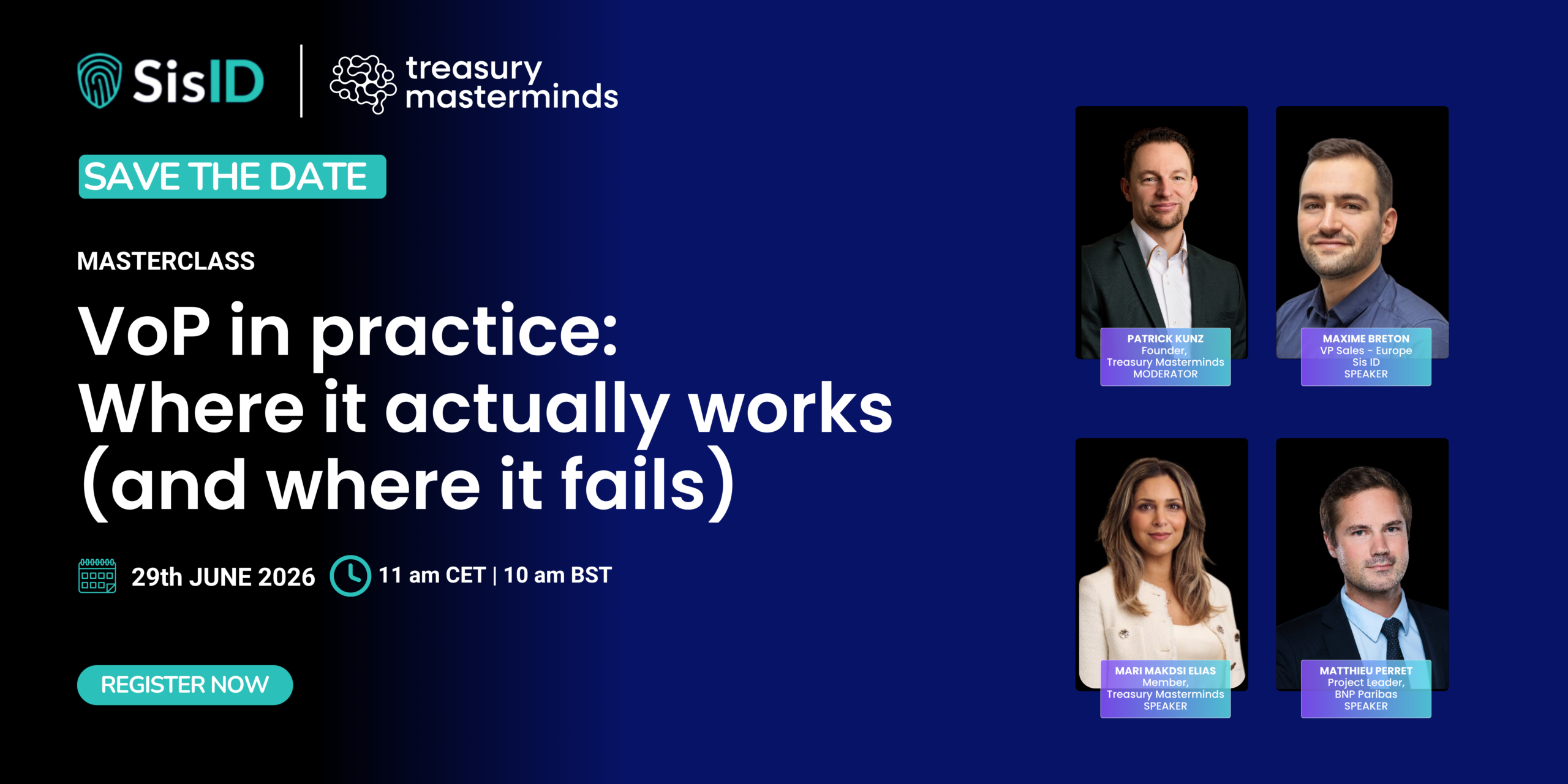
Join us on the 29th of June, 2026 for Masterclass with SisID where Verification of Payee works and where it fails. In this 45-minute session, we take a practical look at how VoP is being used today, and what happens when it meets real-world processes.
We’ll cover:
Click below to register for free and submit any questions you have to the panel ahead of time!
Verification of Payee (VOP) involves several key components that ensure the accuracy and security of payments. These components work together to verify the payee’s account details before processing a payment, thereby preventing fraud and ensuring payment accuracy.
Implementing Verification of Payee (VOP) can present several challenges for banks and Payment Service Providers (PSPs).
However, understanding these challenges and adopting effective solutions can ensure a smooth and successful implementation.
VOP not only builds customer trust by demonstrating a commitment to safeguarding their funds but also ensures compliance with stringent regulatory requirements.
As banks and PSPs have to adopt VOP, they must focus on maintaining high data quality, integrating VOP with existing systems, and educating customers about its benefits. By leveraging advanced technology and staying proactive in addressing challenges, financial institutions can offer a seamless and efficient Verification of Payee service that meets the needs of their customers and enhances the integrity of their payment systems.
Treasury Masterminds is a community of professionals working in treasury management or those interested in learning more about various topics related to treasury management, including cash management, foreign exchange management, and payments. To register and connect with Treasury professionals, click the button below.
This article is written by our partner, SAP Taulia
Stablecoins have evolved from an experimental technology to a tool with the potential to transform corporate treasury – removing many of the barriers to fast and cost-efficient cross-border payments. So what do Treasurers need to do to take advantage? PayPal’s Sharyn Tan and SAP Taulia’s Charles Brough share their takeaways from a recent Treasurers’ Club event.
Stablecoins and digital payments have a vital role to play in reshaping corporate treasury operations. The energy around this topic is palpable – but questions remain around how companies can use stablecoins to enhance liquidity management, improve cash visibility, and streamline cross-border transactions.
To shed light on this topic, Sharyn Tan, Head of Product Liquidity and New Products for Treasury at PayPal, joined a recent Treasurers’ Club event hosted by SAP Taulia’s Charles Brough. During the session, Sharyn shared her views on the role stablecoins can play in transforming treasury and how treasurers can future-proof their working capital strategies.
In this blog, Sharyn and Charles reflect on their key takeaways from the discussion. If you missed the session, or if you’d like a reminder of the main topics covered during the event, read on.
A fundamental shift is underway in the world of payments. The way in which companies manage money is evolving fast – and while traditional payments aren’t going away, stablecoins are emerging as a significant force with the potential to reshape corporate payments.
As we heard during the Treasurers’ Club discussion, what’s driving this evolution is a desire for speed, transparency, and efficiency, particularly in the area of cross-border payments.
But in order to adopt new technologies, companies will first need to adapt their operational models and risk management strategies.
As we heard during the session, not all stablecoins are created equal – so it’s important for treasurers to have a clear understanding of this developing landscape.
Various stablecoins are now available, each with its own backing mechanism and regulatory status. PayPal USD (PYUSD), which is issued by Paxos Trust Company, a New York Department of Financial Services chartered limited purpose trust company, is a regulated stablecoin with one-to-one backing in US dollars and highly liquid short-term US government securities. Other examples of US dollar backed stablecoins include USDT and USDC.
We also discussed the maturing regulatory environment. Governments and regulatory bodies are moving away from outright rejection of stablecoins and are increasingly developing frameworks that enhance consumer protection, adding legitimacy for corporate adoption.
With use cases expanding beyond crypto trading, we are now seeing leading enterprises exploring how they can harness stablecoins to transform their corporate treasury operations – for example, in transactions such as large cross-border dividend payments and intercompany funding as well as paying vendor invoices.
For banks, meanwhile, stablecoins present both challenges and opportunities. On the one hand, stablecoins may play a role in reducing reliance on traditional correspondent banking – but at the same time, banks are looking at ways to integrate stablecoin capabilities and develop interoperability with digital assets.
During the discussion, we talked about some of the ways that corporate treasurers can benefit from stablecoins:
So how can corporate treasury teams best leverage stablecoins? And how can they get started? We believe the following steps are key to making the most of these emerging opportunities:
The future of payments is being shaped by the developments we’re seeing today. To learn more about how your corporate treasury function can prepare for next-generation payments, check out the latest report in our CFO Perspectives series, which you can download here.
Treasury Masterminds is a community of professionals working in treasury management or those interested in learning more about various topics related to treasury management, including cash management, foreign exchange management, and payments. To register and connect with Treasury professionals, click the button below.