I joined Finance & Treasury Services as a Corporate Treasury Manager after finishing my Master’s in “Finance & Accounting” at Leuphana University Lüneburg. While I was studying, I did several internships in corporate treasury departments, which helped me gain a lot of experience in treasury operations and currency management.
For example, I was involved in implementing a new global treasury management system and revising a hedging strategy. Before this, I spent a year in treasury consulting with one of the Big Four accounting firms, where I helped clients set up their treasury functions and improve their organizational, procedural, and methodological approaches. I also have a background in banking, having completed a banking apprenticeship.
1. Corporate Banking: Hard Skills
Since specifically Treasury Management concepts, methods, or instruments are not widely taught in academics as an individual subject like Controlling or Accounting, a sound understanding of corporate banking and cash & risk management, as well as financing products, is important. Treasury really begins with the bank relationship, ergo bank account management, investing and lending cash, etc. Most payment products or banking services are not hard to understand but it’s an advantage to be familiar with the “slang” and environment before starting a job in treasury. “Learning on the job” (see below) or visiting specialized seminars is a common way to develop the necessary skills throughout your career, making sure that you gain the relevant knowledge for your daily operations.
2. Analytical Soft Skills
The fundamental tasks of a Treasury Manager are to create transparency, reduce financial risk, and ensure liquidity and solvency at all times. Where do I need cash, in what currency, and at what time? To answer these questions, you need to create sophisticated, comprehensive reports, that show data about your cash flow. There are many tools out there that help you visualize your cash flow in beautiful-looking tables and graphs. The real pain really starts at the beginning, though. No one likes to (a) collect, (b) save, and (c) clean the data, except you’re a real data wizard. The role of the Treasurer shouldn’t be about this data wrangling but the data analysis itself. You need to feel comfortable digging deep into the numbers and trying to figure out what story they tell.
3. The Rest: Learning on the job
Since every Treasury is different, the requirements of businesses’ cash and risk management and financing can vary a lot. No Treasurer deals with all banking products and services, so you will soon find out what is relevant to your organization and what is not. One of your Treasury fellows might work in a trading company and deal with letters of credit every day, whereas you never understood how to manage them. A second fellow prepares for a bond emission, whereas you are only dealing with simple bank loans. A third fellow is executing the cash status and forecast by the push of a button in their Treasury Management System, while you are still struggling with your manual Excel sheets. This is all completely normal and fine! Always try to improve your workflows and systems, automate processes where you can, and stay up-to-date with skills, trends, challenges, and regulations in Treasury.
1. Resources
Labor market shortages plus the lack of sophisticated higher education, especially Treasury management, create a tight situation for corporations trying to fill their vacancies. Often, they demand experienced treasurers who are simply aging more and more and the young ones are not following fast enough. A temporary solution can be interim managers but in the long run, only universities can help increase the supply of recruits.
2. Budget
Treasury departments are fairly low-staffed compared to other finance departments like controlling or accounting. Many corporations prefer to stack up their technology, trying to make machines do the work more efficiently, rather than hiring for more FTE. Often, approval for these kinds of projects faces a bottleneck at the C-level and budget is the prevailing argument. A well-prepared business case with quantitative and qualitative value is key to winning their hearts on a project like this since the overall goal isn’t normally about gaining a profit from treasury activities.
3. Change Management
In the fast-paced environment of today, new digital skills are needed more than ever. Especially data literacy and agile working methods are promising to cope with new trends in technology and to overcome the old “we always did it this way” mentality. The younger generation knows that there are capabilities and solutions for “getting the job done”. They can be frustrated if the organization is not adapting to the new realities and continues business as usual. Integrating young people into the team brings new ideas to the table since they grow up with different views and approaches.
4. Embrace LinkedIn
Treasury management is a dark niche in the big pond of finance. Connecting to your peers helps you navigate these waters, not only on your own. Many treasurers got to their position where they are more or less my chance since the career path isn’t shown to them after university. Therefore, the feeling of working in a fairly unknown financial terrain should be more of the norm than the exception. A great place to start is connecting on social media platforms, especially on LinkedIn. Today everyone is happy to have a big online network of like-minded people and it’s not weird anymore if you haven’t met the person in real life yet.
5. Subscribe to Newsletters
There are good ways to stay up-to-date in treasury management, such as through online news portals. They offer a wide range of information and ways of presenting it. More and more publishers are even going into direct contact with their audience through webinars and live events. By subscribing to their newsletters, you won’t miss out on newly published articles, invitations for webinars, etc.
6. Attend Live events and join associations
The classic way of meeting people outside the online world never gets old. More and more treasury associations are organizing live events on their own, besides the well-established players. Being a member of an association connects you automatically to like-minded people who also live close to you, likely speak your language, and share the same passion as you.
Setting up a liquidity forecast follows the following steps:
Manual vs. Automated tasks
It may sound like a military drill but measuring the time that you need to finish a task can be eye-opening. Especially when it’s done manually and repetitively. Like a steady drop that will carve the stone, many small daily tasks quickly pile up. Some tools help you measure the time while you’re actually performing the tasks and also record your desktop clicks, etc. As cliché as it sounds, in many cases, time equals money in treasury operations, especially if your team is small or understaffed. Often, this comes as an opportunity cost where your limited time could be used on another, more value-generating task. A best practice is to identify all your tasks. List them in a table, measure the time to execute them, and distinguish between manual and automated tasks and administrative and analytical tasks. Ask yourself how the process could be made leaner, meaning more automated, faster, and more efficient.
In my current role, I get to know many small treasury teams and even one-person treasury departments. They only have two options, i.e. (1) make or (2) buy. Since their personnel is limited, they need to find support in adjacent departments like control, IT, or Accounting. You need to identify key treasury processes and build your treasury operating model with the help of these resources, even if the expertise is not primarily focused on treasury. The keyword is learning-on-the-job.
Implement IC Netting in a TMS
Primarily an accounting topic, it was funny to see that most of the resistance came from the accounting team. Their main concern was the adoption of new procedures and learning the tool. They felt uncomfortable abandoning their habits of doing intercompany clearing like they used to do for a long time. Even if the implementation meant straight-through-processing and therefore faster execution time and less manual work,. We wrote the IC Netting rule book and held several training sessions with the accounting team. Ultimately, they saw the benefits outweighing the doubts. In the end, it was more of a chance management process for their minds than for the technology itself – and good communication was key.
I love and hate TMS selections. I love it since the value it brings to Treasury operations is massive and it saves you so many manual Excel headaches. I hate TMS selections because the standard RFP process feels like something from another century, takes ages, and overburdens many SMEs financially and in terms of personnel. Since almost all TMS vendors are very restrictive with letting you have a demo (look and feel) of your own on their website or social media, you do not have a chance to get to know their software without starting this cumbersome process and displaying genuine interest. My three pieces of advice from many TMS implementations are the following:
I get easily excited by the newer technologies being applied to the Treasury now (RPA, AI, ML/LLM). Since I taught myself the programming language R, Data Analytics, and a bit of UIPath (RPA), I know firsthand what huge benefits these technologies can bring to the table. As a treasurer, though, when it comes to liquidity, the basics matter first. Meaning, that you should first get your processes and data in order (speaking of effectiveness = doing the right thing) before even thinking about applying newer technologies to them (speaking of efficiency = doing things right).
Understanding the basics of these technologies is beneficial for treasurers, as they can help automate routine tasks, improve decision-making processes, and enhance efficiency. However, the level of expertise needed may vary depending on the complexity of treasury operations and the organization’s strategic objectives. As much as I enjoyed my R programming project in one job, my skills were not needed at another job because they didn’t need them. You need to apply your knowledge to keep it. The need is highly dependent on the cash flow data, business model, and economic situation the company finds itself in. If these technologies can bring high value and potentially save money, the business case and ROI are easier to prove. I would say that RPA is beneficial in most cases since all treasurers are doing repetitive tasks every day. The value of Machine Learning (predictive analytics, fraud detection, etc.) is not clear from the beginning and needs deeper analysis. Here, the help of external experts is advised since this domain is fairly new and normally exceeds the treasurer’s expertise.
Automation
The future of treasury management lies in automation, data analytics, and AI-driven decision-making. Treasury Management Systems (TMS) were built to help you manage treasury processes. Hopefully, you will get rid of the manual, tedious, repetitive data administration work and can focus on value-bringing, analytical tasks that will be insightful for the financial decision-making process and provide value to the organization. In the future, I see the Treasurer more as the financial Data Analyst and the TMS as the most important tool to achieve “Management by Exception”. I think we will see generative AI embedded in the TMS, creating reports by just speaking to it (speech-to-task), e.g.:
“Hey TMS, show me the cash forecast for the next 12 months for the DACH Region” or
“Hey TMS, please sell 1 million USD at the end of the month via our Multi-Dealer Platform.”
“Don’t be afraid of technology. See it as a tool that helps you become a real Sparring partner on the board.”

Treasury Masterminds is a community of professionals working in treasury management or those interested in learning more about various topics related to treasury management, including cash management, foreign exchange management, and payments. To register and connect with Treasury professionals, click [HERE] or fill out the form below to get more information.
This article is written by Natixis Investment Managers
In the first wave of the digital finance industry, neobanks and neobrokers won over customers with intuitive apps, low fees and instant account opening. But with the increasing maturity of the market, these advantages are no longer sufficient. Today, the design of the user interface no longer decides how effectively platforms manage and optimize the liquidity of their customers.
Retail investors and young savers now expect one thing above all: that their money never just lies around. They want security, flexibility and competitive returns – even on cash balances. This is where many digital platforms fail. For digital providers, it is more than just a “nice-to-have” to offer significant liquidity solutions. These have become one of the most important levers to keep users with themselves, strengthen their attachment to the platform and stand out in an increasingly crowded market. And this is where asset managers can play an important role.
Cash credit is often underestimated in the fintech world – in the background, it shapes almost every decision that digital customers make: whether it is the opening of an account or how long they park their money, which platform they entrust to their investments or how actively they act or save. If customers receive little or nothing on their unused cash balance, then of course they shift it elsewhere. And this leads to lower activities, high customer churn and ultimately to falling yields.
Platforms that offer intelligent liquidity solutions, on the other hand, experience a very different dynamic. Clients stay longer, a larger share of their assets remain on the platform, and both trading and investment activities tend to increase. These platforms create a user experience that feels completely rather than purely transactional – and thus strengthens the customer relationship and long-term loyalty.
Many neobanks and neobrokers actually already offer attractive returns, which are often increased by promotional interest or short-term incentives. But return is only part of the story – and the part that is easiest to copy. What actually sets one platform apart from others is something else. It’s not about how high the advertised interest rate is, but what the quality and resilience of the underlying liquidity architecture is.
For private customers, liquidity solutions offer something that temporarily high returns cannot: consistency, security and predictability across different market cycles. Temporarily highly advertised interest rates lead to deposits, but do not automatically deepen engagement and do not create trust. Thoughtful liquidity products, on the other hand, deliver both attractive and stable earnings, protect capital and are reliable even in volatile markets. They convey to customers that they can leave their balance in good conscience invested longer, rather than moving it from one promotional offer to the next.
Platforms can benefit from this. Instead of causing a stir with costly interest rate campaigns, they can consolidate customer relationships through sustainable value – driven by a robust liquidity infrastructure rather than marketing budgets.
Digital vendors are not trying to reinvent themselves as asset managers; they want to provide their clients with simple, reliable investment options that they can trust right from the start. For this, they need pragmatic, ready-to-go solutions that can be seamlessly integrated into their existing infrastructure, institutional and easily implementable liquidity management, and products with stable, transparent returns that private customers also understand. Above all, they are looking for strategies that remain robust over different market cycles: solutions that work both at rising and falling interest rates and in all scenarios in between. In short, they are looking for partners who care about the complexity in the background so that they can fully concentrate on the service for their users.
In this environment, working with an asset manager can create attractive returns and institutional stability can be a strategic advantage.
B2B fintech company: The rise of neobanks as a partner for corporate treasuries
In addition, there are further changes in the corporate Treasury sector in particular that could fundamentally change the way companies operate their cash management.
In its latest Annual Global Payments Report 11, the Boston Consulting Group describes its annual report on global payment transactions that these changes are proceeding faster and faster: “Disruptive innovations are changing the structure of payment transactions and reshaping cash flows. Established market participants must adapt their business and operating models fundamentally – and above all quickly.”
There are several drivers for this change – one of which is the downsizing of Treasury departments: companies are forced to do more with fewer resources, and therefore increasingly strive for efficiency. The increased use of AI helps to increase this efficiency, and finally, the rise of neobanks in recent years has forced even the slowest established providers to gain more agility.
As digitally designed platforms, they are usually faster when adopting new technologies – whether for real-time payments or API integration. And hardly anything suggests that they are planning to throttle their pace. In addition, they are increasingly advancing into the area of cash management. There was, for example, a neobank that adopted a digital treasury solution platform and has thus been able to offer its customers extended cash management functions since then – including a uniform investment interface for “untapped liquidity” of SMEs.
The more neobanks and other fintechs scale, the more their treasury functions develop from a supportive to a strategic role. In a low margin environment, every component of the business must make a maximum contribution – and this includes cash management. Whether by optimizing your own processes by making better use of the managed deposits or by a particularly wide range of services for customers: It is certain that they will drive a change across the entire system.
For digital providers, choosing the right liquidity partner is not a mere question of procurement, but a strategic decision. Digital platforms compete in an environment where customer loyalty, brand trust, and user experience determine survival.
In this context, an asset manager with a deep and diversified supply of liquidity solutions is far more than just a product provider. Natixis Investment Managers brings the scale, reliability and expertise that digital providers need to expand their offerings. With liquidity assets of over 50 billion euros 3 managed by our affiliated specialized investment manager Ostrum Asset Management, as well as over four decades of experience across all market cycles, Natixis Investment Managers has made a name for itself as a provider of stable, transparent and resilient cash management solutions.
Our offer goes far beyond traditional money market funds. We cover the full range of liquidity strategies – from ultra-short solutions with daily access to short-term credit strategies that can increase return while preserving liquidity. With the help of a global multi-boutique model with more than 15 specialized affiliates, hundreds of analysts and portfolio managers, as well as a strong presence in Europe, we offer digital platforms easy-to-integrate products, customized solutions, operational simplicity and the security of risk management at the highest level.
In a market that relies on trust and performance, Natixis Investment Managers combines scale with flexibility, helping digital providers strengthen their value proposition, deepen customer loyalty, and create the long-term stability their customers expect.
Even though many neobanks and neobrokers now offer top returns, the real difference is how smart these returns are structured. Private customers do not all behave the same: some hold liquidity for the daily payment transactions, others have larger balances for medium-term goals, and many build up a security cushion before investing. And here it becomes clear how effective cash animaling is. By offering different layers of liquidity – solutions with instant access for daily needs, strategies with a slightly longer duration for a higher return, and short-term credit funds for customers who want additional returns – they can offer each customer segment the right ratio of return and availability. Instead of a single, undifferentiated interest rate, digital providers can create a completely individual user experience that feels tailor-made and transparent. Cash Tiering across different investment horizons not only optimizes the results for customers – it also deepens customer loyalty, encourages higher deposits on the platform and positions liquidity as a well-thought-out, value-creating service rather than a mere promotional interest.
Natixis Investment Managers and Ostrum AM offer a range of liquidity solutions designed for different levels of return and availability. These include:
1. Classic Money Market Fund (MMFs)
Ultra-short strategies that provide daily access and a conservative profile. They are ideal for:
A selection of the MMFs from Ostrum AM ranges from very short-term investment horizons (1 day) to terms of 1-3 months and combines safety, daily availability and ESG integration.
2. Short-running investment strategies
For customers who also like to accept slightly longer investment horizons – usually of a few months – platforms can offer higher returns – and with high liquidity and low volatility. These strategies are used to invest in:
Funds of Ostrum AM with short investment duration include 6- to 12-month loan strategies.
3. Advanced liquidity solutions
These are strategies designed to achieve higher returns while maintaining daily liquidity. You can supplement MMFs by providing:
Ostrum AM’s expanded liquidity solutions include ultra-short credit funds as well as short-running lending strategies for investment horizons between 6 and 24 months.
These solutions help platforms offer staggered liquidity and create premium options for highly active customers.
Money market funds and short-term pension funds are an attractive investment opportunity for short-term liquidity – from daily money or money. Overnight liquidity up to medium- to long-term liquidity with maturities of up to 24 months. The funds invest in a broadly diversified portfolio of high-quality, short-running securities and offer attractive returns in addition to daily liquidity. These funds are regulated and must meet certain criteria. Since they do not have fixed maturities, they can react flexibly to changing capital market conditions.
There are two types of money market funds: short-term money market funds and standard money market funds. The table compares the characteristics of money market and short-term bond funds:
| Short-running MMFs | Standard MMFs | Short-term pension funds | |
|---|---|---|---|
| Maximum term of assets | 397 Tage | 2 Jahre | Keine |
| Maximum average maturity of assets | 120 Tage | 12 Monate | Keine |
| Maximum weighted average runtime (duration) | 60 Tage | 6 Monate | Keine, aber in der Regel 2 Jahre |
| Average rating | AA-A | AA-A | A-BBB |
| Minimum rating | BBB-* | BBB- | Keine |
| Minimum daily liquidity ratio | 7,5 %** | 7,5 % | Keine |
| Minimum weekly liquidity ratio | 15 %*** | 15 % | Keine |
| Recommended holding time | Über Nacht bis zu 1 Monat | 1 | Bis zu 3 Monate >3 Monate (6 bis 24 Monate) |
| Cash / Cash equivalents | Ja | Ja | Nein |
The main risks of liquidity solutions are credit risk, interest rate risk and liquidity risk, with credit risk being the most significant of the three. Credit risk is reduced by high diversification and the focus on high-quality issuers. In the event of systematic market declines, such as those observed in the global financial crisis of 2007 or the outbreak of Covid 2020, standard money market funds, and in particular short-term pension funds, will experience temporary price volatility. Short-term money market funds should remain stable even in extreme market environments.
Money market funds generally have very little interest rate risk, and liquidity risk is kept low by investing only in high-liquid securities. Yet, as with credit risk, liquidity risk for some funds in extreme market environments may increase. Short-term bond funds can take on more credit, interest and liquidity risk than money market funds, which is why investors need to consider the recommended holding periods before investing in any type of fund in the field of liquidity solutions
The next growth chapter for digital platforms is not about flashy user interfaces or marketing campaigns. Instead, it comes down to something simpler and more fundamental – namely, how they help customers make their money work, every day and in any market environment.
Liquidity is becoming a new competitive advantage. And with strong partners and the right products, digital platforms can transform liquidity from a passive function to a strong magnet for customer retention and long-term loyalty.
Treasury Masterminds is a community of professionals working in treasury management or those interested in learning more about various topics related to treasury management, including cash management, foreign exchange management, and payments. To register and connect with Treasury professionals, click the button below.
From Treasury Masterminds
Many treasury teams believe ISO 20022 is largely behind them.
After all, payment files have been migrated, banks have updated their channels, ERP providers have released new formats, and most organisations have survived the initial transition without major disruption.
Unfortunately, November 2026 suggests otherwise.
The next major milestone in the ISO 20022 journey is approaching, and it could have a far bigger operational impact than many treasury teams realise.
Several payments organisations and market infrastructures have identified November 2026 as the next critical milestone in the global ISO 20022 migration.
While much of the attention over the past few years focused on payment initiation and reporting messages, the next phase extends deeper into payment investigations, enquiries and exception handling.
Financial institutions will increasingly be expected to process investigation and enquiry messages using ISO 20022 MX standards rather than legacy formats.
At the same time, structured data requirements continue to expand across the payments ecosystem.
In simple terms, the industry is moving beyond simply sending payments in ISO 20022 format. The focus is now shifting towards how payments are investigated, repaired, tracked and reported when something goes wrong.
And as every treasurer knows, that is often where the real operational challenges begin.
Recent industry surveys paint a mixed picture.
While significant progress has been made, a considerable number of financial institutions remain behind schedule in several key areas:
The challenge is not necessarily sending payments.
The challenge is handling the increasingly rich data that accompanies those payments throughout their lifecycle.
Historically, many payment investigations relied on manual processes, free-text fields and significant human intervention.
ISO 20022 aims to replace much of that ambiguity with structured information.
That is good news for efficiency.
It is less good news for organisations whose systems, processes or data models are not yet prepared.
It is tempting to view ISO 20022 as primarily a banking project.
That would be a mistake.
Corporate treasury sits at the centre of payment operations, liquidity management and bank connectivity. As banks continue their migration efforts, treasury teams will inevitably feel the impact.
Three areas deserve particular attention.
Many treasury projects officially closed their ISO 20022 workstreams months or even years ago.
That does not mean testing can stop.
Banks continue to introduce enhancements, new requirements and additional message types. Treasury teams should maintain regular dialogue with their banking partners and continue validating connectivity between:
The organisations that experience the fewest issues tend to be the ones that treat connectivity as an ongoing process rather than a one-time project.
One of the major promises of ISO 20022 is better transparency throughout the payment lifecycle.
Investigations, recalls, returns and exception handling processes are increasingly dependent on structured information.
When payment data is incomplete, inconsistent or poorly mapped, resolution times can increase significantly.
Treasury teams should therefore pay close attention to:
The quality of payment data is rapidly becoming just as important as the payment itself.
Many organisations completed their ISO 20022 projects based on minimum compliance requirements.
That was often the correct decision at the time.
However, as banks and market infrastructures continue expanding their use of ISO 20022 capabilities, treasury teams should revisit previous assumptions.
Questions worth asking include:
A quick health check today is significantly cheaper than a remediation project next year.
ISO 20022 is often described as a messaging standard.
In reality, it is becoming a data standard.
The long-term value lies not in XML files but in richer, more structured information flowing across the financial ecosystem.
That data will support:
The organisations that treat ISO 20022 purely as a compliance exercise may meet the deadline.
The organisations that treat it as a data transformation opportunity are likely to gain the greatest benefits.
November 2026 may not generate the same headlines as the original migration deadlines, but it represents another important step in the industry’s ISO 20022 journey.
For treasurers, the message is simple.
Don’t assume ISO 20022 is finished.
Keep testing. Keep validating data quality. Keep challenging vendors and banking partners.
Because in payments, the difficult part is rarely sending the payment.
It is dealing with everything that happens after it leaves your account.
Treasury Masterminds is a community of professionals working in treasury management or those interested in learning more about various topics related to treasury management, including cash management, foreign exchange management, and payments. To register and connect with Treasury professionals, click the button below.
This article is written by SisID
The European Instant Payment Regulation (IPR) requires payment service providers (PSPs) to set up a beneficiary verification mechanism. This mechanism has to follow the Verification of Payee (VOP) scheme, in order to comply with the regulation. VOP provides a seamless way for banks and PSPs to ensure that the account details provided by the requesting party match those of the intended payee. By verifying the payee’s account details before processing a payment, VOP helps prevent misdirected payments and reduces the risk of fraud.
Verification of Payee (VOP) is a European initiative aimed at protecting users of payment systems from fraud. As part of the Instant Payment Regulation (IPR), VOP ensures that the bank account number matches the name of the payee before processing a payment. The IPR is a legislative proposal from the European Commission designed to standardize and promote instant transfers within the SEPA (Single Euro Payments Area) zone. These instant transfers allow funds to be transferred in less than 10 seconds, 24 hours a day, 7 days a week, providing a fast and modern alternative to traditional payments, which are often slower. By implementing VOP, banks and Payment Service Providers (PSPs) can enhance the security and accuracy of payments, responding to requests for verification in real-time and reducing the risk of fraud.
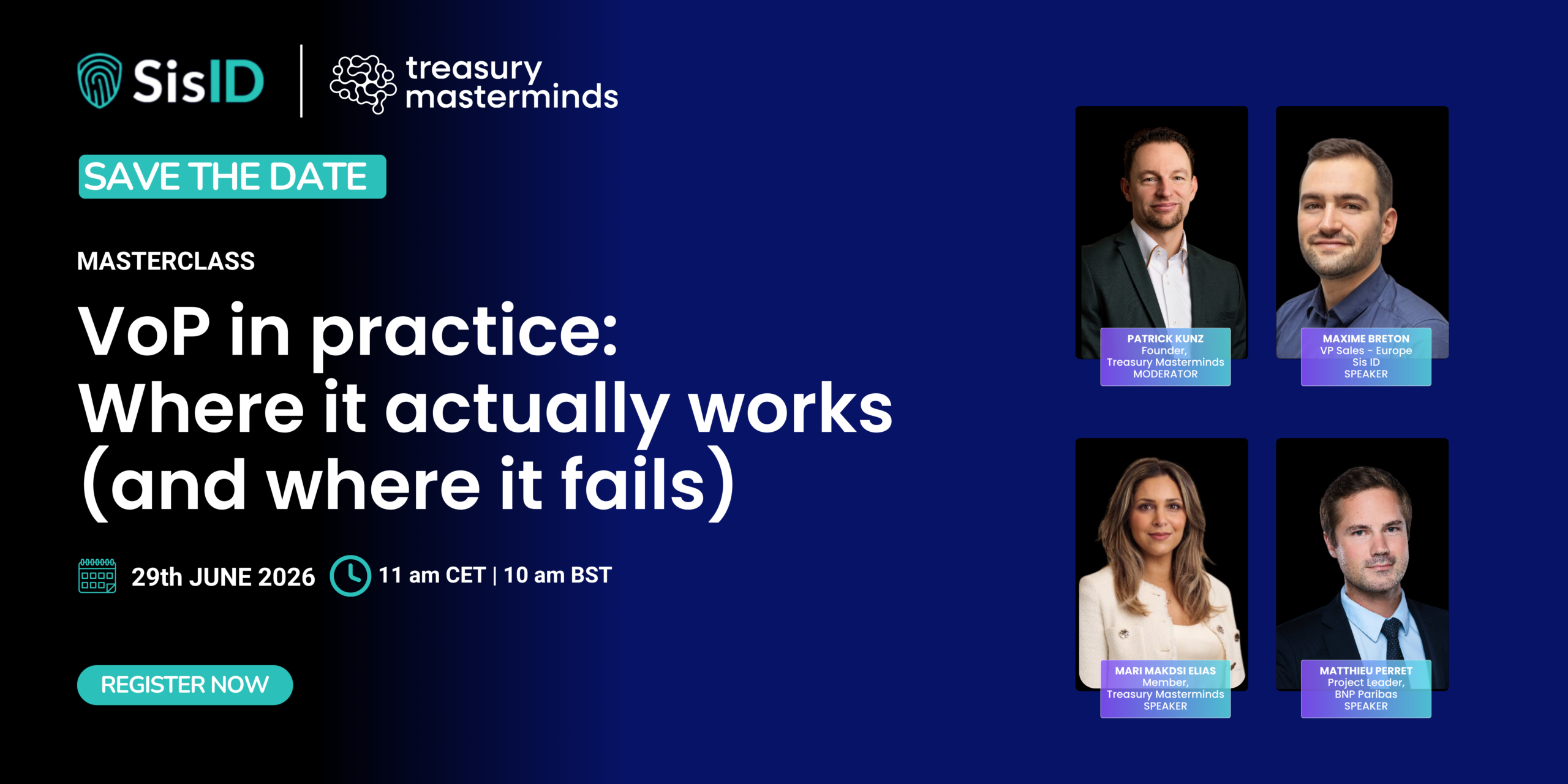
Join us on the 29th of June, 2026 for Masterclass with SisID where Verification of Payee works and where it fails. In this 45-minute session, we take a practical look at how VoP is being used today, and what happens when it meets real-world processes.
We’ll cover:
Click below to register for free and submit any questions you have to the panel ahead of time!
Verification of Payee (VOP) involves several key components that ensure the accuracy and security of payments. These components work together to verify the payee’s account details before processing a payment, thereby preventing fraud and ensuring payment accuracy.
Implementing Verification of Payee (VOP) can present several challenges for banks and Payment Service Providers (PSPs).
However, understanding these challenges and adopting effective solutions can ensure a smooth and successful implementation.
VOP not only builds customer trust by demonstrating a commitment to safeguarding their funds but also ensures compliance with stringent regulatory requirements.
As banks and PSPs have to adopt VOP, they must focus on maintaining high data quality, integrating VOP with existing systems, and educating customers about its benefits. By leveraging advanced technology and staying proactive in addressing challenges, financial institutions can offer a seamless and efficient Verification of Payee service that meets the needs of their customers and enhances the integrity of their payment systems.
Treasury Masterminds is a community of professionals working in treasury management or those interested in learning more about various topics related to treasury management, including cash management, foreign exchange management, and payments. To register and connect with Treasury professionals, click the button below.